From the article
Anomaly Detection — News, Updates & Deep Dives
Author
- Adam Yates
- Aditya Kulkarni
- Adrian Bridgwater
- Agustín Gallego
- Alex Woodie
- Alexander Marshalov
- Aliaksandr Valialkin
- Aman Agarwal
- Antony Savvas
- Artem Navoiev
- Bill Tanner
- Cer6erus
- Claudio Masolo
- David Marshall
- Denys Holius
- Derek Foster
- Diana Todea
- Dima Lazerka
- Dmytro Kozlov
- Emily Foster
- Fintech Herald
- Fred Navruzov
- Gary Flood
- Gonzalo García Labat
- Ivan Yatskevich
- Jaime Hampton
- Jan Sokol
- Jason Bloomberg
- Jason English
- Jean-Jerome Schmidt-Soisson
- Jesús Espino
- Joab Jackson
- John Seekins
- Jose Gomez-Selles
- Julien Menan
- Karan Virdi
- Laveesh Kocher
- Leigh McGowran
- Lindsay Clark
- Marc Sherwood
- Mark Baker
- Martijn Van Best
- Martin Veitch
- Mathias Palmersheim
- Michelle Sebek
- Nick Gibson
- Nikolay Khramchikhin
- Pablo Fernandez
- Phuong Le
- Rafal Szypulka
- Renato Losio
- Richard Speed
- Roman Khavronenko
- Vadim Alekseev
- Vadim Rutkovsky
- Yurii Kravets
- Zakhar Bessarab
- Zhu Jiekun
No matching authors found.
Category
- Benchmark
- Community
- Company News
- Customer Stories
- Developer Experience
- Distributed Tracing
- Events
- Go
- Go @ VictoriaMetrics
- High Cardinality
- Kubernetes
- Monitoring
- Observability
- Open Source Tech
- OpenTelemetry
- OTLP
- Performance
- PostgreSQL
- Product News
- Tech Talk
- Time Series Database
- VictoriaLogs
- VictoriaMetrics
- VictoriaTraces
No matching categories found.
Filter: Anomaly Detection
Blog posts
Observability's Sixth Sense: Grounding Anomaly Detection in Reality
Learn how VictoriaMetrics combines machine learning, MCP, and natural-language workflows to simplify observability with anomaly detection and reduce operational overhead.
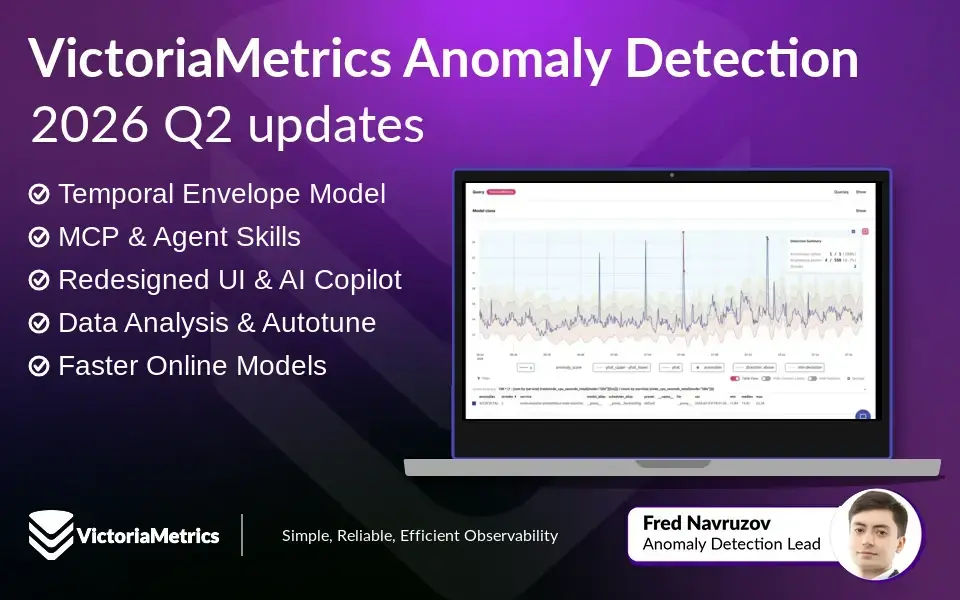
What's new in VictoriaMetrics Anomaly Detection (Q2 2026)
The Q2 2026 vmanomaly update introduces Temporal Envelope, a redesigned UI, faster online-model execution, and an AI-assisted workflow that turns natural-language monitoring goals into tested configurations and alerting rules.
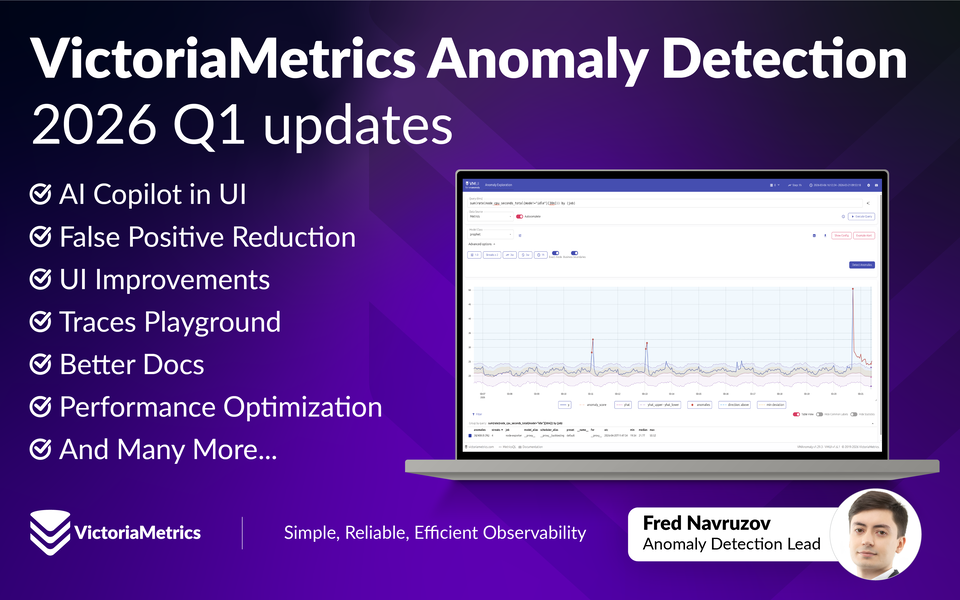
What's new in VictoriaMetrics Anomaly Detection (Q1 2026)
Q1 2026 brought incremental but important updates to VictoriaMetrics Anomaly Detection: UI improvements, AI assistance inside the UI, a public traces playground, new false-positive reduction controls, and continued resource optimizations.
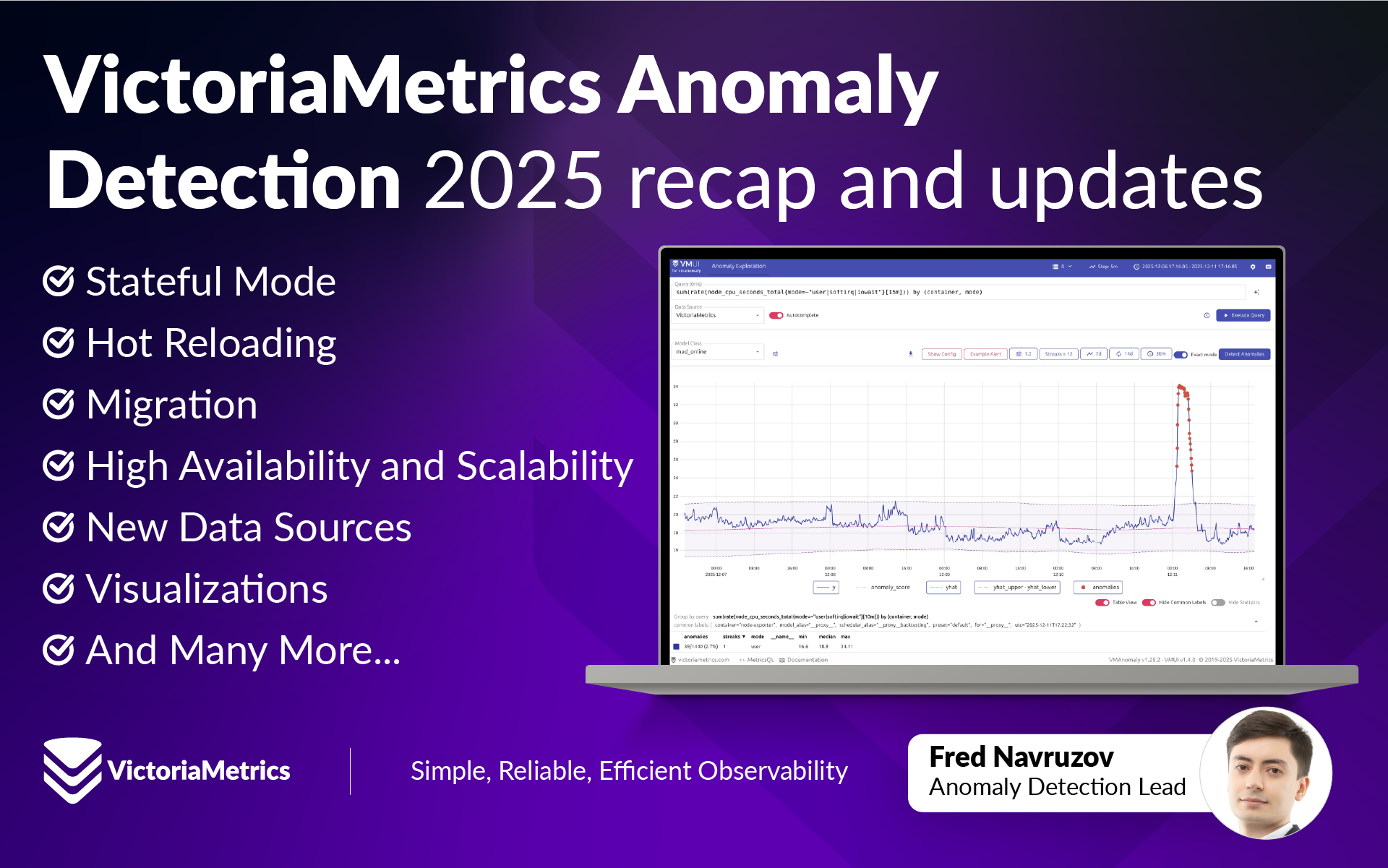
What’s new in VictoriaMetrics Anomaly Detection (2025)
VictoriaMetrics Anomaly Detection has had a productive year with lots of user feedback that has had a major impact on product development. We’ve added improvements across the board: in core functionality, simplicity, performance, visualisation and AI integration. In addition to bug fixes and speedups, below is a list of what was accomplished in 2025.
How a US Software Provider Improved Traffic Alerting with VictoriaMetrics Anomaly Detection
VictoriaMetrics Anomaly Detection enables reliable alerting for highly variable, multi-domain traffic without relying on static thresholds. In this case study, fine-tuned models, backtesting, and clear visualization helped reduce alert noise, improve confidence in anomaly detection, and lower operational overhead.
VictoriaMetrics Anomaly Detection: What's New in Q3 2024?
Explore the latest improvements in VictoriaMetrics Anomaly Detection (vmanomaly), including optimizations, online models, multitenantcy and mTLS support.
VictoriaMetrics Anomaly Detection: What's New in H1 2024?
Explore the latest improvements in VictoriaMetrics Anomaly Detection (vmanomaly), including presets, new models, enhanced tuning, and better resource management

VictoriaMetrics Machine Learning takes monitoring to the next level
Announcing VictoriaMetrics Anomaly Detection solution, which harnesses machine learning to make database alerts more relevant, accurate and actionable for enterprise customers.
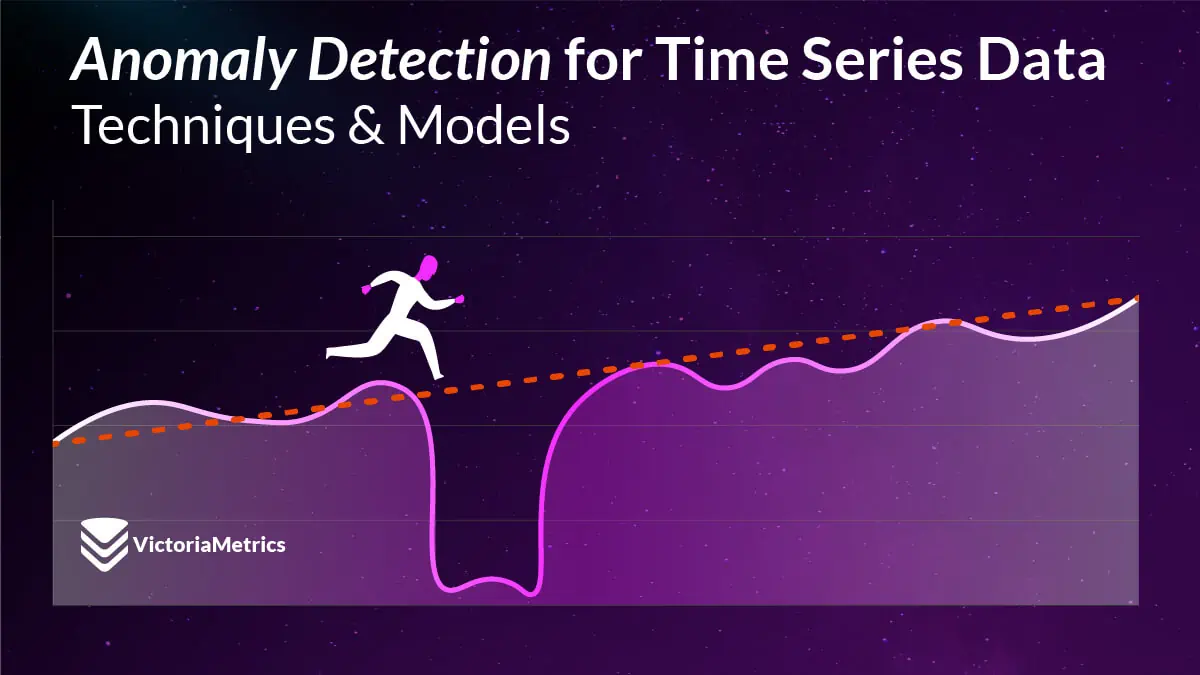
Anomaly Detection for Time Series Data: Techniques and Models
This blog post series centers on Anomaly Detection (AD) and Root Cause Analysis (RCA) within time-series data. In Chapter 3, we delve into a variety of advanced anomaly detection techniques, encompassing supervised, semi-supervised, and unsupervised approaches, each tailored to different data scenarios and challenges in time-series analysis.