- Blog /
- vmalert: Maximize Your Monitoring
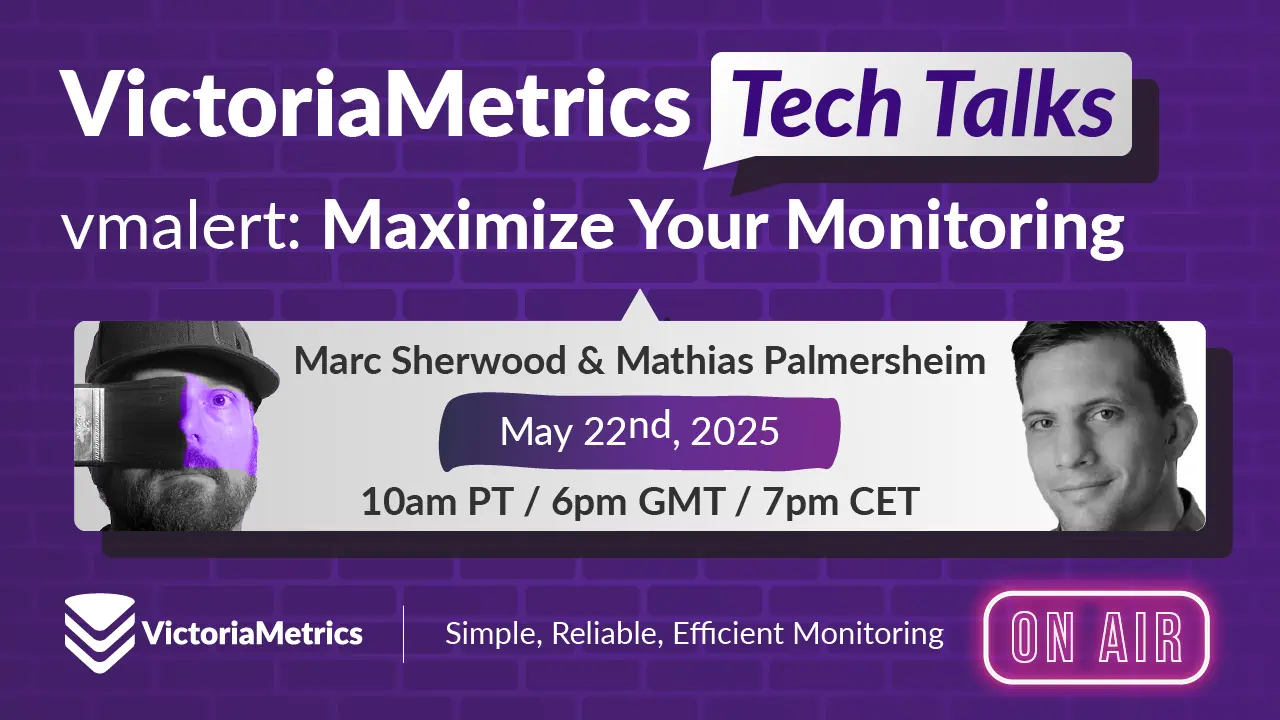
vmalert: Maximize Your Monitoring
Share:


Join the live stream
#
📅 When: Thursday, May 22, 2025, at 10:00 AM PDT
📺 Link: Watch on YouTube
📅 Add to calendar: Google Outlook Apple
Get ready for the next installment of our VictoriaMetrics Tech Talk series! We’re excited to announce Episode 5, broadcasting live on Thursday, May 22nd, 2025, at 10:00 AM Pacific Time (PDT).
This time, we’re diving into a critical component for operational excellence: vmalert.
Effective alerting is the backbone of proactive monitoring, enabling teams to detect and respond to issues swiftly before they impact users. But setting up truly effective alerting – alerts that are reliable, actionable, and low-noise – requires understanding the tools and best practices.
That’s exactly what this Tech Talk will cover.
Join us for “Mastering vmalert: Best Practices for Effective Alerting”, where we’ll explore how to leverage vmalert to its full potential within the VictoriaMetrics ecosystem.
What You’ll Learn
#
Whether you’re just starting with vmalert or looking to refine your existing configuration, this session will provide valuable insights, including:
vmalert Fundamentals
Understand its role, architecture, and how it integrates with VictoriaMetrics and Alertmanager.Configuration Essentials
Learn the key settings for getting vmalert up and running smoothly.Writing Effective Rules
Discover best practices for crafting alerting and recording rules that are clear, efficient, and meaningful.Labels vs. Annotations
Understand the difference and how to use them effectively for routing, context, and runbook linking.Taming Alert Noise
Learn the importance of theforclause and other techniques to avoid alert fatigue.Common Pitfalls
We’ll highlight frequent mistakes and how you can steer clear of them.Practical Demo
See vmalert in action — from rule evaluation to notification.
Who Should Attend?
#
This talk is ideal for:
- DevOps Engineers
- SREs
- System Administrators
- Developers or operators responsible for monitoring and alerting using VictoriaMetrics
Event Details
#
- Topic: Mastering vmalert: Best Practices for Effective Alerting
- Date: Thursday, May 22nd, 2025
- Time: 10:00 AM PDT / 1:00 PM EDT / 5:00 PM UTC (Please verify your local time)
- Duration: ~60 minutes, including live Q&A
- Platform: YouTube Live
Ready to transform your alerting strategy?
#
Don’t miss this opportunity to learn directly from the experts and ask your questions live!
We look forward to seeing you there and helping you enhance your monitoring capabilities with VictoriaMetrics and vmalert.
Feel free to share this with colleagues who might benefit!
Leave a comment below or Contact Us if you have any questions!
comments powered by Disqus
You might also like:
Announcing vmestimator: Real-time Cardinality Estimations for VictoriaMetrics and Prometheus
vmestimator is a new open-source tool that estimates metric cardinality in real time. It can alert to high-cardinality spikes before they slow queries and increase resource usage. Works with any Prometheus-compatible setups, Grafana, and vmalert
Multi-tiered Observability: A Practical Way to Handle Diverse Workloads
Discover multi-tier observability architecture with VictoriaMetrics OSS. Learn how to isolate default, high-cardinality, and business-critical workloads into separate tiers with optimized retention periods, ingestion resolution, cardinality limits, alerting policies, and cost controls.
Alerting Best Practices
Proper alerting is an art. It is all about foreseeing bad scenarios before they happen, so you can prepare for them. In this article, we go through practical recommendations of approaching the alerting to reduce alerting fatigue and avoid false positives.