- Blog /
- From Chaos to Clarity with VictoriaLogs
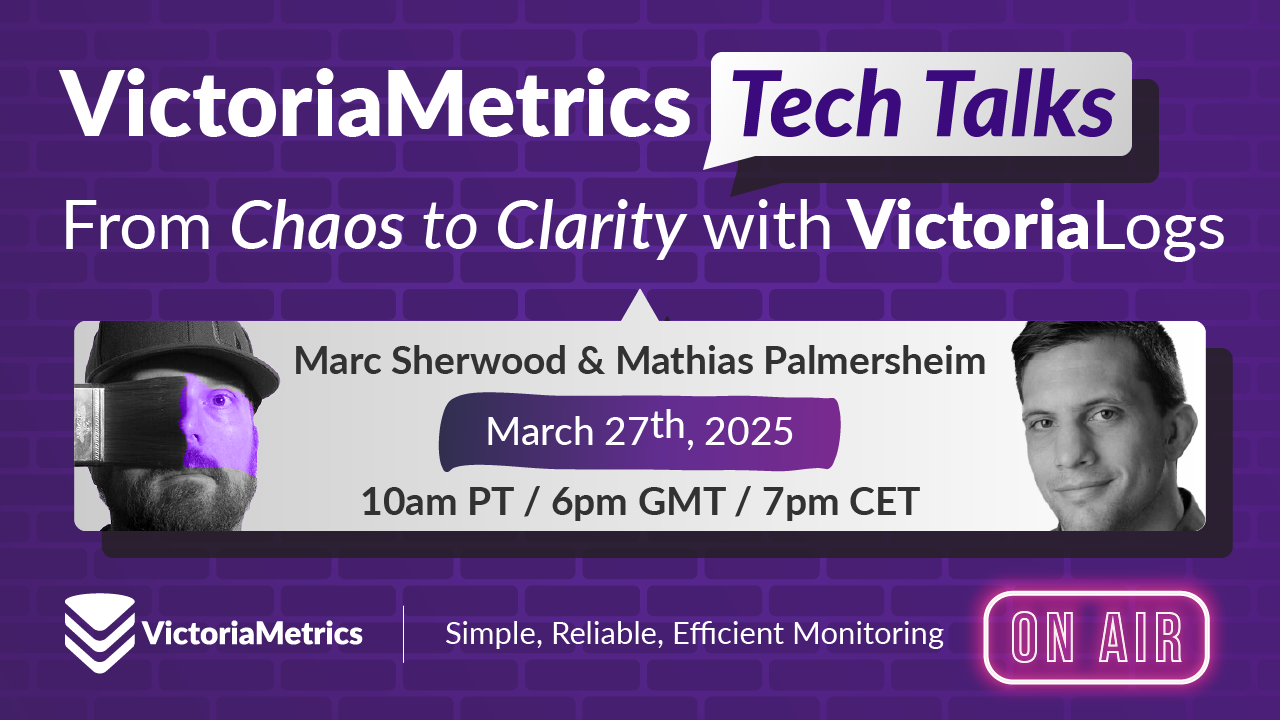
From Chaos to Clarity with VictoriaLogs
Share:


Join the live stream
#
When: Thursday, March 27, 2025, at 10:00am PDT / 6pm GMT / 7pm CET
Link: https://www.youtube.com/watch?v=KbQcAoSZE
From Chaos to Control: The VictoriaLogs Approach
#
Log data is a treasure trove of information, but only if you can effectively manage and analyze it. Traditional logging solutions often struggle with:
- Volume: The sheer volume of logs generated by modern applications can be overwhelming, and expensive.
- Velocity: Logs are generated constantly, requiring real-time ingestion and processing.
- Variety: Logs come in various formats and from diverse sources, making standardization a challenge.
- Veracity: Ensuring the accuracy and reliability of log data is crucial for making informed decisions.
VictoriaLogs is designed to address these challenges head-on, offering an open source, powerful, scalable, and cost-effective solution for log management.
What We Cover (or, What You’ll Learn)
#
This session will cover the following key areas:
- Introduction to VictoriaLogs
- Brief overview of VictoriaLogs and its core features.
- Key benefits of using VictoriaLogs, including its performance, scalability, and cost-effectiveness compared to other solutions.
- How VictoriaLogs fits into a modern observability stack.
- Efficient Ingestion and Optimization
- Step-by-step guidance on ingesting logs from various sources into VictoriaLogs. This might include:
- Using popular agents like Vector, Telegraf, and Opentelemetry collector.
- Direct ingestion via API.
- Techniques for optimizing your log pipelines, such as:
- Filtering irrelevant logs at the source to reduce volume.
- Parsing and structuring logs for efficient querying.
- Using Recording rules for summarizing logs as metrics
- Enriching logs to add app owners to log data
- Step-by-step guidance on ingesting logs from various sources into VictoriaLogs. This might include:
- Best Practices for Streamlining Your Logging Processes
- Establishing clear logging standards across your organization.
- Implementing a centralized logging strategy.
- Choosing the right log levels (DEBUG, INFO, WARN, ERROR, FATAL) for different situations.
- Using structured logging formats (like JSON) for easier parsing and analysis.
- Incorporating contextual information (e.g., user IDs, transaction IDs) into your logs.
- Enhancing Performance and Scalability
- Understanding VictoriaLogs’ architecture and how it scales.
- Tuning VictoriaLogs for optimal performance based on your specific needs.
- Monitoring the health and performance of your VictoriaLogs deployment.
- Real-World Examples
- Examples could include:
- Troubleshooting application errors using log data.
- Identifying performance bottlenecks.
- Detecting security threats.
- Monitoring user behavior.
- Improving resource utilization.
- Examples could include:
- Q&A with the VictoriaLogs Team
Key Takeaways
#
- VictoriaLogs provides a powerful and efficient solution for managing large volumes of log data.
- Optimizing your log pipelines is crucial for gaining valuable insights and reducing costs.
- Best practices, such as structured logging and filtering, can significantly improve your logging efficiency.
- VictoriaLogs is designed for scalability and performance, allowing you to handle growing log volumes with ease.
Resources for Further Learning
#
- Click here for the live stream, or to set a 🔔 reminder on YouTube
From Chaos to Clarity With Victorialogs - Get hands on with VictoriaLogs today and experience the benefits firsthand!
https://victoriametrics.com/products/victorialogs/
Leave a comment below or Contact Us if you have any questions!
comments powered by Disqus