- Blog /
- From Chaos to Clarity with VictoriaLogs
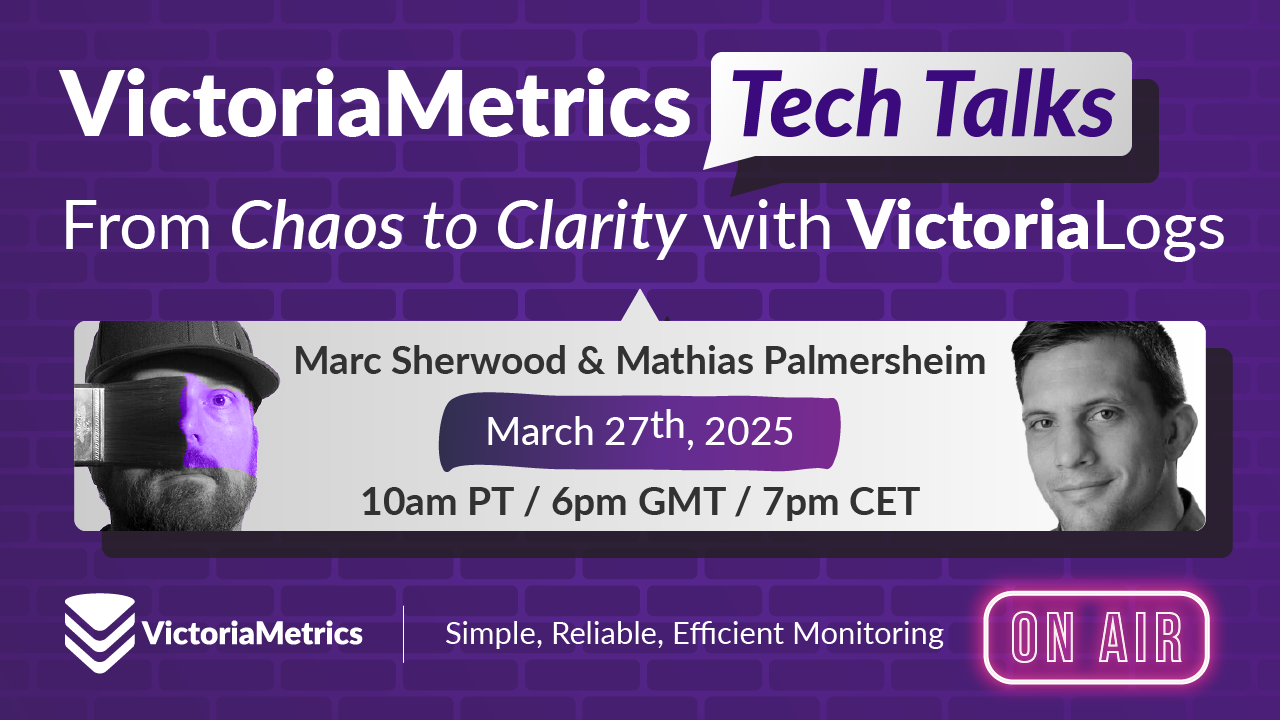
From Chaos to Clarity with VictoriaLogs
Share:


Join the live stream
#
When: Thursday, March 27, 2025, at 10:00am PDT / 6pm GMT / 7pm CET
Link: https://www.youtube.com/watch?v=KbQcAoSZE
From Chaos to Control: The VictoriaLogs Approach
#
Log data is a treasure trove of information, but only if you can effectively manage and analyze it. Traditional logging solutions often struggle with:
- Volume: The sheer volume of logs generated by modern applications can be overwhelming, and expensive.
- Velocity: Logs are generated constantly, requiring real-time ingestion and processing.
- Variety: Logs come in various formats and from diverse sources, making standardization a challenge.
- Veracity: Ensuring the accuracy and reliability of log data is crucial for making informed decisions.
VictoriaLogs is designed to address these challenges head-on, offering an open source, powerful, scalable, and cost-effective solution for log management.
What We Cover (or, What You’ll Learn)
#
This session will cover the following key areas:
- Introduction to VictoriaLogs
- Brief overview of VictoriaLogs and its core features.
- Key benefits of using VictoriaLogs, including its performance, scalability, and cost-effectiveness compared to other solutions.
- How VictoriaLogs fits into a modern observability stack.
- Efficient Ingestion and Optimization
- Step-by-step guidance on ingesting logs from various sources into VictoriaLogs. This might include:
- Using popular agents like Vector, Telegraf, and Opentelemetry collector.
- Direct ingestion via API.
- Techniques for optimizing your log pipelines, such as:
- Filtering irrelevant logs at the source to reduce volume.
- Parsing and structuring logs for efficient querying.
- Using Recording rules for summarizing logs as metrics
- Enriching logs to add app owners to log data
- Step-by-step guidance on ingesting logs from various sources into VictoriaLogs. This might include:
- Best Practices for Streamlining Your Logging Processes
- Establishing clear logging standards across your organization.
- Implementing a centralized logging strategy.
- Choosing the right log levels (DEBUG, INFO, WARN, ERROR, FATAL) for different situations.
- Using structured logging formats (like JSON) for easier parsing and analysis.
- Incorporating contextual information (e.g., user IDs, transaction IDs) into your logs.
- Enhancing Performance and Scalability
- Understanding VictoriaLogs’ architecture and how it scales.
- Tuning VictoriaLogs for optimal performance based on your specific needs.
- Monitoring the health and performance of your VictoriaLogs deployment.
- Real-World Examples
- Examples could include:
- Troubleshooting application errors using log data.
- Identifying performance bottlenecks.
- Detecting security threats.
- Monitoring user behavior.
- Improving resource utilization.
- Examples could include:
- Q&A with the VictoriaLogs Team
Key Takeaways
#
- VictoriaLogs provides a powerful and efficient solution for managing large volumes of log data.
- Optimizing your log pipelines is crucial for gaining valuable insights and reducing costs.
- Best practices, such as structured logging and filtering, can significantly improve your logging efficiency.
- VictoriaLogs is designed for scalability and performance, allowing you to handle growing log volumes with ease.
Resources for Further Learning
#
- Click here for the live stream, or to set a 🔔 reminder on YouTube
From Chaos to Clarity With Victorialogs - Get hands on with VictoriaLogs today and experience the benefits firsthand!
https://victoriametrics.com/products/victorialogs/
Leave a comment below or Contact Us if you have any questions!
comments powered by Disqus
You might also like:
How VictoriaLogs Stores Your Logs in a Columnar Layout
A beginner-friendly tour of how VictoriaLogs stores your logs on disk: streams and daily partitions, immutable parts, blocks and columns, and the files inside a part (timestamps, values, bloom filters, column headers, and the two-level index) that let a query read only the bytes it needs.
VictoriaLogs: Gaps, Gains & Growth
In our fourth VictoriaMetrics Tech Talks episode, we wrapped up our deep dive into logs and summarized the key takeaways for effective log management. This installment concluded our log series, featuring Co-founder and CTO Alex who joined to share some exciting news and updates from VictoriaMetrics.
Why we generate & collect logs: About the usability & cost of modern logging systems
This blog post looks at what logs are and why they matter, why logs are generated and collected as well as at the costs associated with that. It also provides details on why VictoriaLogs should be considered over similar solutions.