From the article
VictoriaMetrics Observability Blog
Author
- Adam Yates
- Aditya Kulkarni
- Adrian Bridgwater
- Agustín Gallego
- Alex Woodie
- Alexander Marshalov
- Aliaksandr Valialkin
- Aman Agarwal
- Antony Savvas
- Artem Navoiev
- Bill Tanner
- Cer6erus
- Claudio Masolo
- David Marshall
- Denys Holius
- Derek Foster
- Diana Todea
- Dima Lazerka
- Dmytro Kozlov
- Emily Foster
- Fintech Herald
- Fred Navruzov
- Gary Flood
- Gonzalo García Labat
- Ivan Yatskevich
- Jaime Hampton
- Jan Sokol
- Jason Bloomberg
- Jason English
- Jean-Jerome Schmidt-Soisson
- Jesús Espino
- Joab Jackson
- John Seekins
- Jose Gomez-Selles
- Julien Menan
- Karan Virdi
- Laveesh Kocher
- Leigh McGowran
- Lindsay Clark
- Marc Sherwood
- Mark Baker
- Martijn Van Best
- Martin Veitch
- Mathias Palmersheim
- Michelle Sebek
- Nick Gibson
- Nikolay Khramchikhin
- Pablo Fernandez
- Phuong Le
- Rafal Szypulka
- Renato Losio
- Richard Speed
- Roman Khavronenko
- Vadim Alekseev
- Vadim Rutkovsky
- Yurii Kravets
- Zakhar Bessarab
- Zhu Jiekun
No matching authors found.
Category
- Benchmark
- Community
- Company News
- Customer Stories
- Developer Experience
- Distributed Tracing
- Events
- Go
- Go @ VictoriaMetrics
- High Cardinality
- Kubernetes
- Monitoring
- Observability
- Open Source Tech
- OpenTelemetry
- OTLP
- Performance
- PostgreSQL
- Product News
- Tech Talk
- Time Series Database
- VictoriaLogs
- VictoriaMetrics
- VictoriaTraces
No matching categories found.
Filter: Victoriametrics
Blog posts
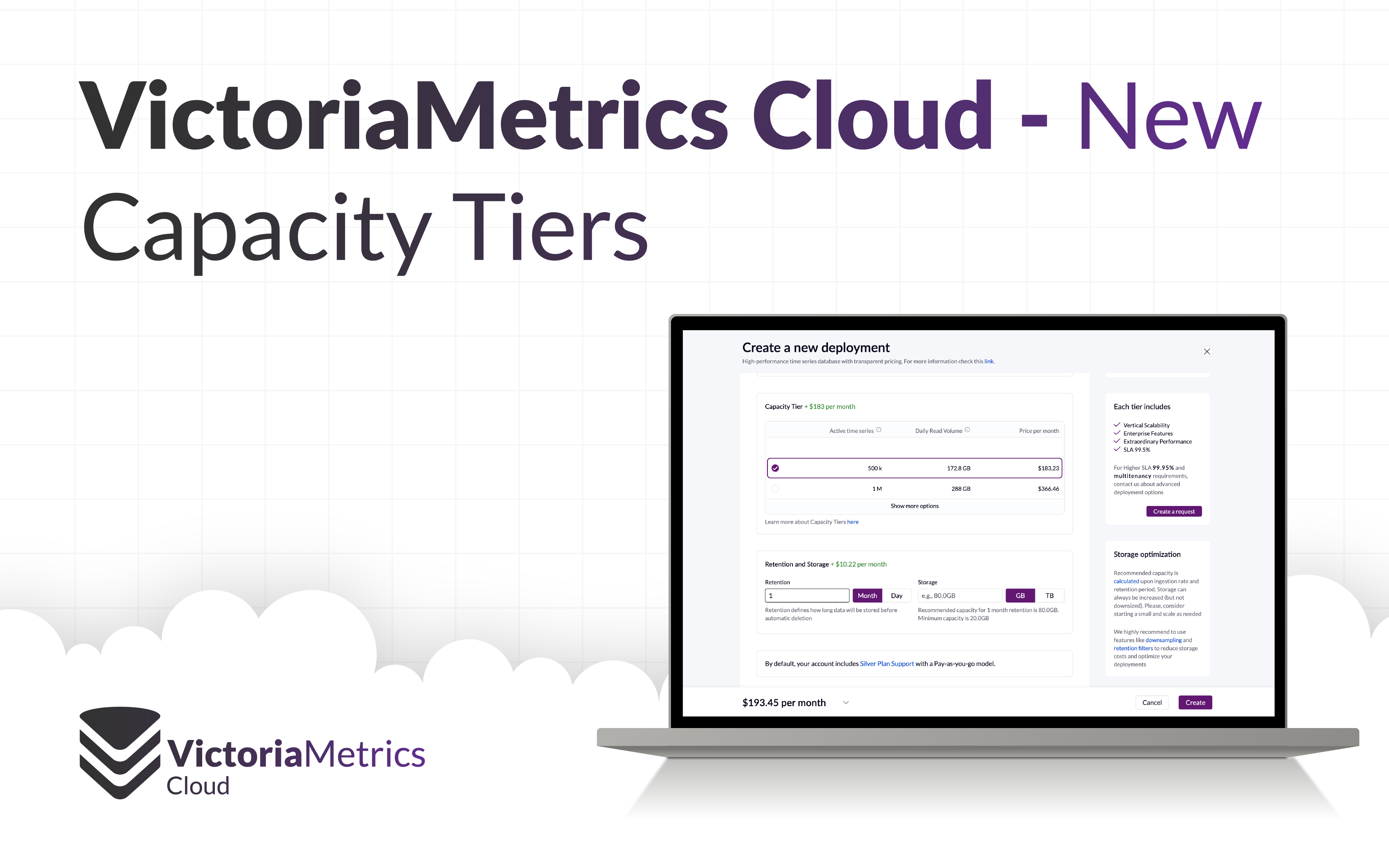
New Capacity Tiers in VictoriaMetrics Cloud
VictoriaMetrics Cloud introduces a reworked set of Single-Node Capacity Tiers, built from fresh benchmarking to provide a clear progression of compute power. The new tiers offer significantly more CPU and memory, narrower gaps between sizes, and consistent pricing.
Announcing 1B+ Downloads & Product Development With Logs, Traces, Metrics
This year saw us blast past the 1 billion downloads on Docker, which is fueled by our customer-centric approach to software development and the introduction of new open source projects, such as our new database for traces. Read this blog post to learn more about our 2025 milestones.
AI Agents Observability with OpenTelemetry and the VictoriaMetrics Stack
Learn how to add observability to AI agents using OpenTelemetry and the VictoriaMetrics Stack. This guide explains how to instrument popular LLM frameworks and visualize metrics, logs, and traces in Grafana.
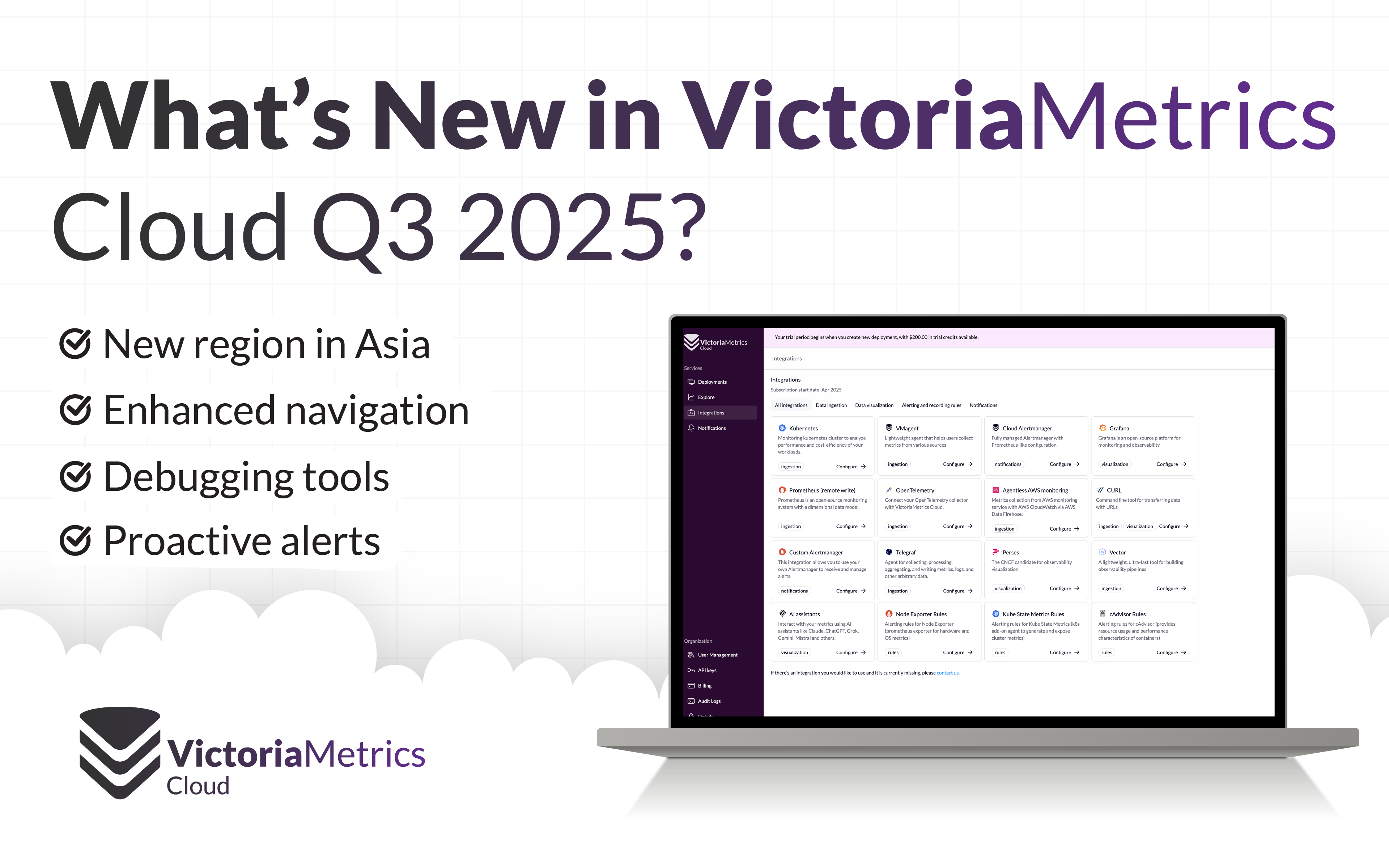
What's New in VictoriaMetrics Cloud Q3 2025? From new region in Asia to proactive alerts
Discover the latest updates in VictoriaMetrics Cloud that make observability smoother, smarter, and more secure.
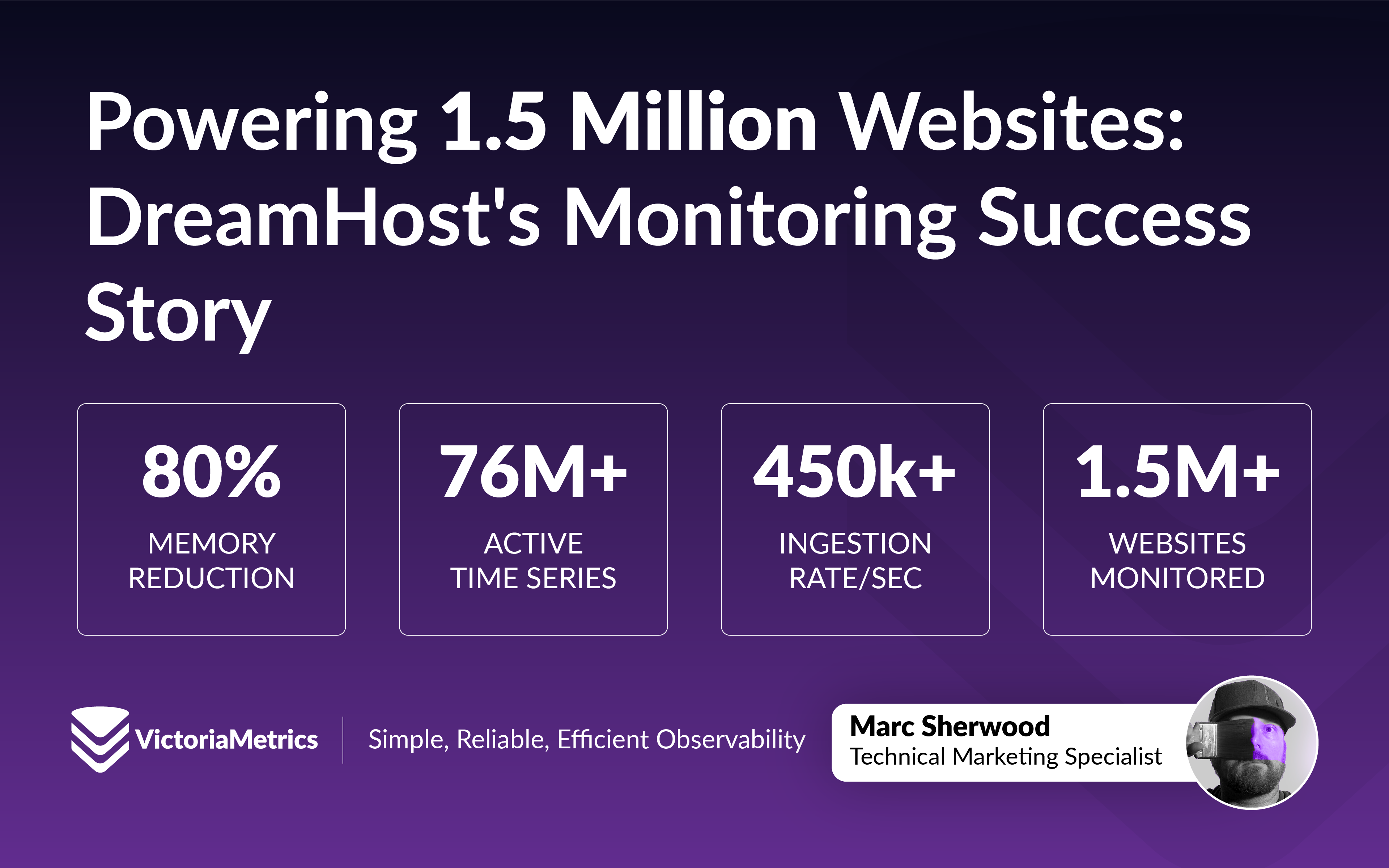
How DreamHost Slashed Memory Usage by 80% and Scaled to 76 Million Time Series
VictoriaMetrics delivers a complete open-source observability stack, combining a highly scalable time series database with a powerful log management system. This streamlined, single-binary solution simplifies deployment while providing fast, cost-effective monitoring and logging at any scale.
VictoriaMetrics Long-Term Support (LTS): H2 2025 Update
As we’re half-way through the year, we’d like to take this opportunity to provide an update on the most recent changes in our Long-Term Support (LTS) releases.

Creating a Sustainable Open Source Business Model - Introduction
Open source defies everything you’ve ever heard or learned about business before. This blog post is an introduction to how we’re creating a sustainable business model rooted in open source.
Full-Stack Observability with VictoriaMetrics in the OTel Demo
The OpenTelemetry Astronomy Shop demo has long served as a reference environment for exploring observability in distributed systems, but until now it shipped with only a Prometheus datasource. VictoriaMetrics forked the demo and extended it with VictoriaMetrics, VictoriaLogs, and VictoriaTraces, providing insights into VictoriaMetrics’ observability stack where metrics, logs, and traces flow into a unified backend.
vmanomaly Deep Dive: Smarter Alerting with AI (Tech Talk Companion)
Tech Talk: In this post, we explore vmanomaly through the eyes of its creators. Learn how this AI-powered alerting system helps cut through noise, avoid static rule spaghetti, and deliver actionable insights directly from your monitoring data.