From the article
VictoriaMetrics Observability Blog
Author
- Adam Yates
- Aditya Kulkarni
- Adrian Bridgwater
- Agustín Gallego
- Alex Woodie
- Alexander Marshalov
- Aliaksandr Valialkin
- Aman Agarwal
- Antony Savvas
- Artem Navoiev
- Bill Tanner
- Cer6erus
- Claudio Masolo
- David Marshall
- Denys Holius
- Derek Foster
- Diana Todea
- Dima Lazerka
- Dmytro Kozlov
- Emily Foster
- Fintech Herald
- Fred Navruzov
- Gary Flood
- Gonzalo García Labat
- Ivan Yatskevich
- Jaime Hampton
- Jan Sokol
- Jason Bloomberg
- Jason English
- Jean-Jerome Schmidt-Soisson
- Jesús Espino
- Joab Jackson
- John Seekins
- Jose Gomez-Selles
- Julien Menan
- Karan Virdi
- Laveesh Kocher
- Leigh McGowran
- Lindsay Clark
- Marc Sherwood
- Mark Baker
- Martijn Van Best
- Martin Veitch
- Mathias Palmersheim
- Michelle Sebek
- Nick Gibson
- Nikolay Khramchikhin
- Pablo Fernandez
- Phuong Le
- Rafal Szypulka
- Renato Losio
- Richard Speed
- Roman Khavronenko
- Vadim Alekseev
- Vadim Rutkovsky
- Yurii Kravets
- Zakhar Bessarab
- Zhu Jiekun
No matching authors found.
Category
- Benchmark
- Community
- Company News
- Customer Stories
- Developer Experience
- Distributed Tracing
- Events
- Go
- Go @ VictoriaMetrics
- High Cardinality
- Kubernetes
- Monitoring
- Observability
- Open Source Tech
- OpenTelemetry
- OTLP
- Performance
- PostgreSQL
- Product News
- Tech Talk
- Time Series Database
- VictoriaLogs
- VictoriaMetrics
- VictoriaTraces
No matching categories found.
Filter: Observability
Blog posts
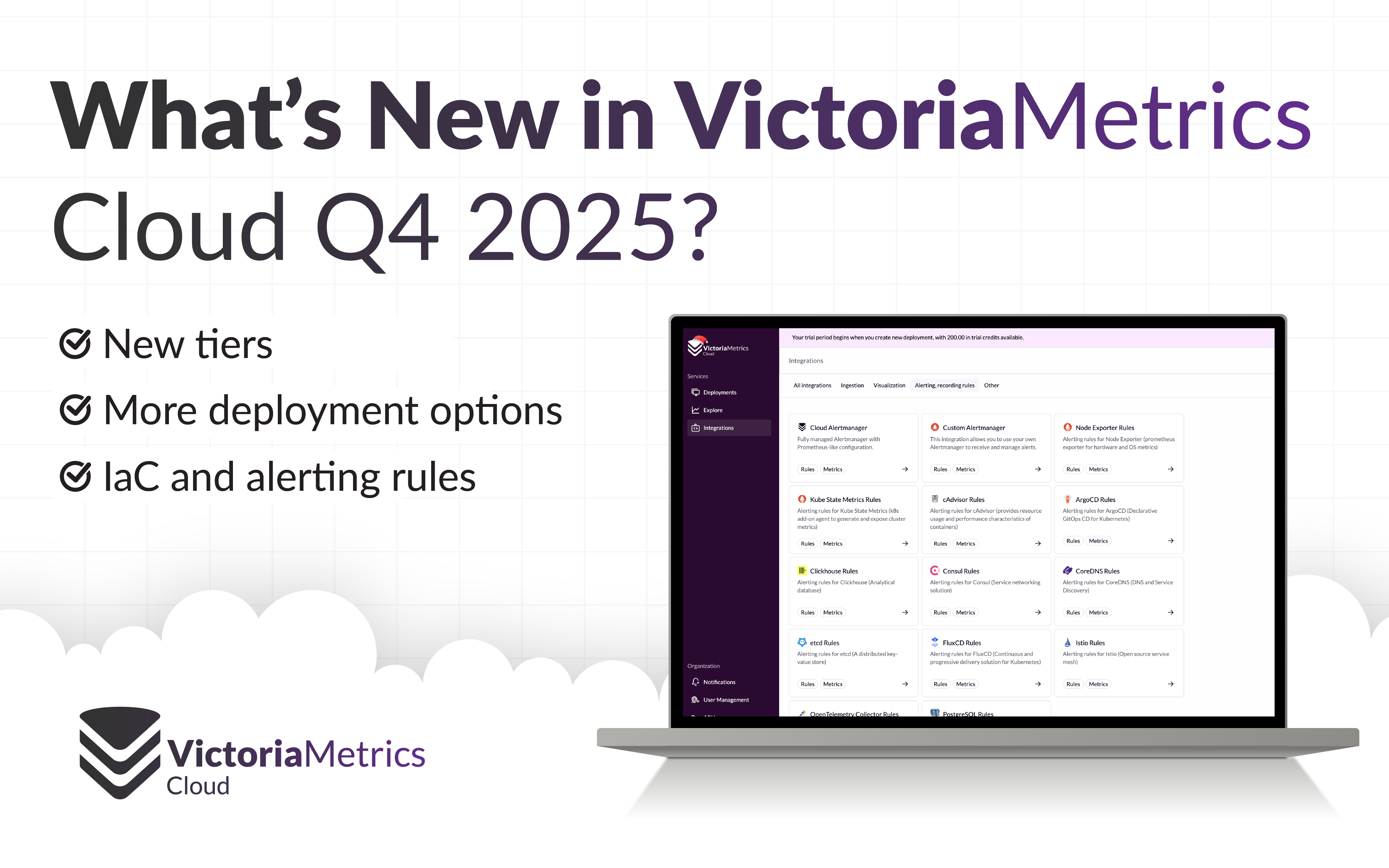
What's New in VictoriaMetrics Cloud Q4 2025? New tiers, more deployment options, IaC and alerting rules.
In the last quarter of 2025, VictoriaMetrics Cloud brings many great features: New powerful Capacity Tiers, the expansion to the us-east-1 (N.Virginia) AWS region in the US, new Notification Groups, a Terraform provider to complete your IaC, 9 brand new Alerting Rule Integrations and much more.
Vibe coding tools observability with VictoriaMetrics Stack and OpenTelemetry
Learn how to add observability to Vibe Coding Tools using OpenTelemetry and the VictoriaMetrics Stack. This guide explains how to configure popular vibe coding tools to export their metrics telemetry and get insights about your vibe coding sessions.
VictoriaMetrics 2025 Developer Experience: A Year in Review
In 2025, VictoriaMetrics deepened its commitment to open source, community, and developer experience across the global cloud-native ecosystem. This year-in-review reflects on key observability themes, global engagement, OpenTelemetry contributions, and the people and conversations that shaped the year.
Spotify’s performance & control across large monitoring environments with VictoriaMetrics
Spotify needed to replace its legacy in-house time series database to overcome stability and performance limitations, which would bring about query delays and timeouts. The Spotify observability team chose VictoriaMetrics to support efficient metric ingestion, querying, and alerting at scale.
VictoriaMetrics Achieves Red Hat OpenShift Operator Certification
Becoming a Red Hat OpenShift Certified Operator brings portability and scalability benefits on the leading enterprise Kubernetes platform.
Our latest updates across the VictoriaMetrics Observability ecosystem
The VictoriaMetrics ecosystem continues to evolve rapidly, and the latest updates bring meaningful improvements across metrics, logs, and traces. Read the announcement for details.
Announcing 1B+ Downloads & Product Development With Logs, Traces, Metrics
This year saw us blast past the 1 billion downloads on Docker, which is fueled by our customer-centric approach to software development and the introduction of new open source projects, such as our new database for traces. Read this blog post to learn more about our 2025 milestones.
AI Agents Observability with OpenTelemetry and the VictoriaMetrics Stack
Learn how to add observability to AI agents using OpenTelemetry and the VictoriaMetrics Stack. This guide explains how to instrument popular LLM frameworks and visualize metrics, logs, and traces in Grafana.
Discarding gRPC-Go: The Story Behind OTLP/gRPC Support in VictoriaTraces
Why did VictoriaTraces build gRPC support without using gRPC-Go? And what are the benefits of adopting a simple HTTP/2 server and easyproto?