From the article
VictoriaMetrics Observability Blog
Author
- Adam Yates
- Aditya Kulkarni
- Adrian Bridgwater
- Agustín Gallego
- Alex Woodie
- Alexander Marshalov
- Aliaksandr Valialkin
- Aman Agarwal
- Antony Savvas
- Artem Navoiev
- Bill Tanner
- Cer6erus
- Claudio Masolo
- David Marshall
- Denys Holius
- Derek Foster
- Diana Todea
- Dima Lazerka
- Dmytro Kozlov
- Emily Foster
- Fintech Herald
- Fred Navruzov
- Gary Flood
- Gonzalo García Labat
- Ivan Yatskevich
- Jaime Hampton
- Jan Sokol
- Jason Bloomberg
- Jason English
- Jean-Jerome Schmidt-Soisson
- Jesús Espino
- Joab Jackson
- John Seekins
- Jose Gomez-Selles
- Julien Menan
- Karan Virdi
- Laveesh Kocher
- Leigh McGowran
- Lindsay Clark
- Marc Sherwood
- Mark Baker
- Martijn Van Best
- Martin Veitch
- Mathias Palmersheim
- Michelle Sebek
- Nick Gibson
- Nikolay Khramchikhin
- Pablo Fernandez
- Phuong Le
- Rafal Szypulka
- Renato Losio
- Richard Speed
- Roman Khavronenko
- Vadim Alekseev
- Vadim Rutkovsky
- Yurii Kravets
- Zakhar Bessarab
- Zhu Jiekun
No matching authors found.
Category
- Benchmark
- Community
- Company News
- Customer Stories
- Developer Experience
- Distributed Tracing
- Events
- Go
- Go @ VictoriaMetrics
- High Cardinality
- Kubernetes
- Monitoring
- Observability
- Open Source Tech
- OpenTelemetry
- OTLP
- Performance
- PostgreSQL
- Product News
- Tech Talk
- Time Series Database
- VictoriaLogs
- VictoriaMetrics
- VictoriaTraces
No matching categories found.
Filter: Map
Blog posts
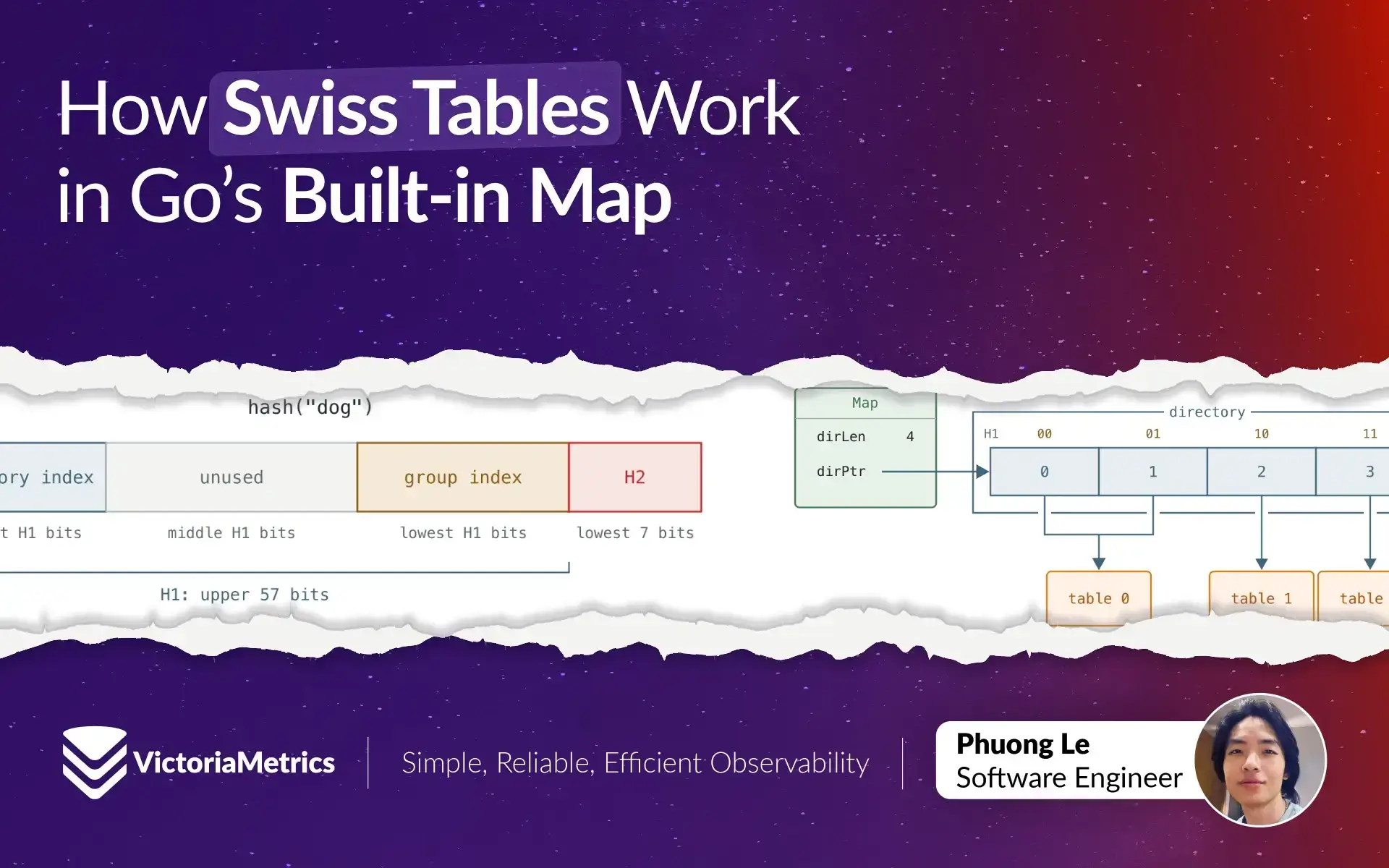
How Go’s Built-in Map Works with Swiss Tables
Go 1.24 replaced the built-in map’s bucket-based runtime with Swiss Tables. This article explains groups, control bytes, H1 and H2, probing, table growth, directories, deletion, load factor, and the experimental split-group layout.
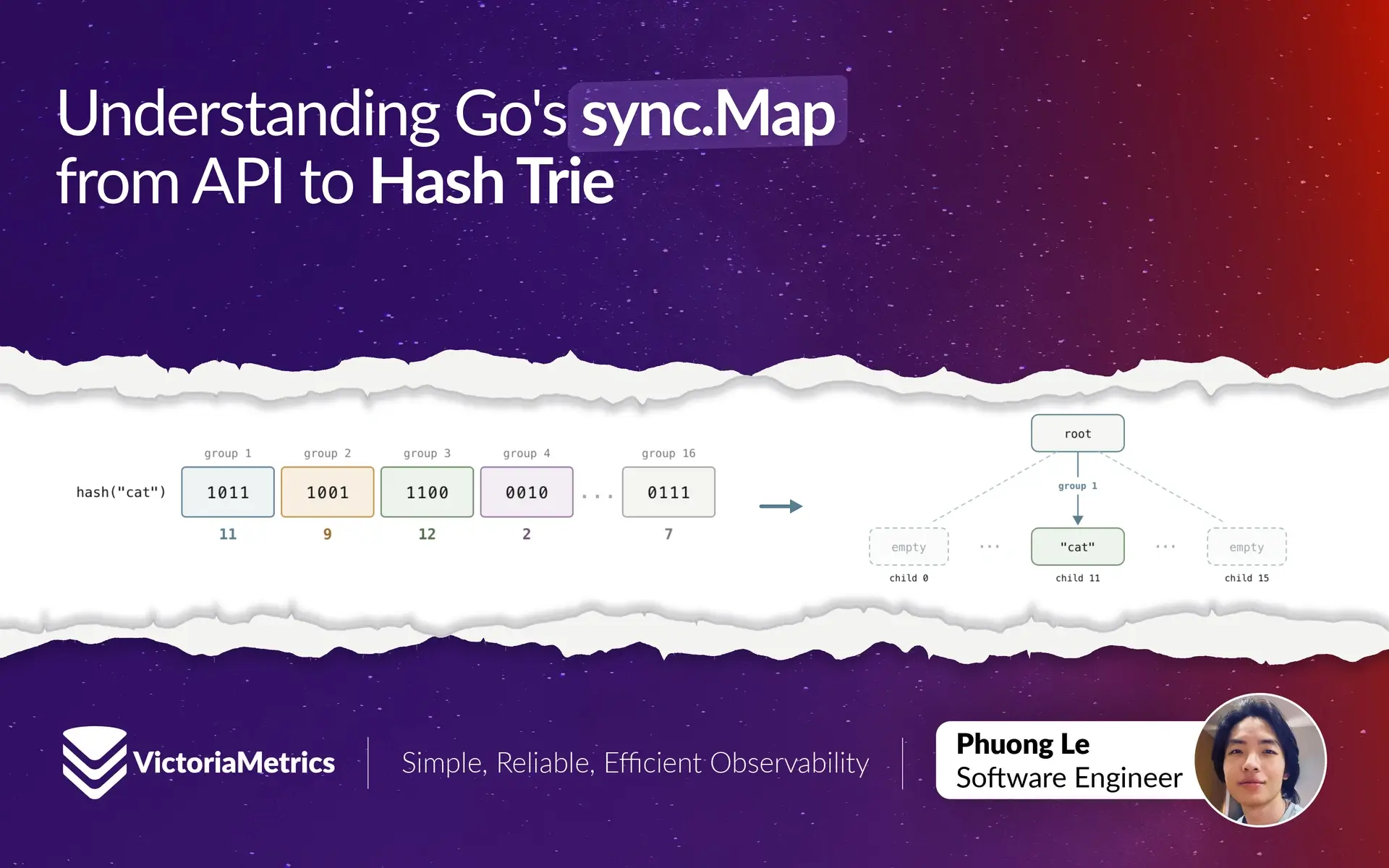
Understanding Go's sync.Map from API to Hash Trie
Go’s sync.Map now uses a hash trie. This article builds the implementation from a normal map, then explains lock-free reads, fine-grained writer locking, collisions, retries, deletion, Clear, Range, and the trade-offs against map plus RWMutex.
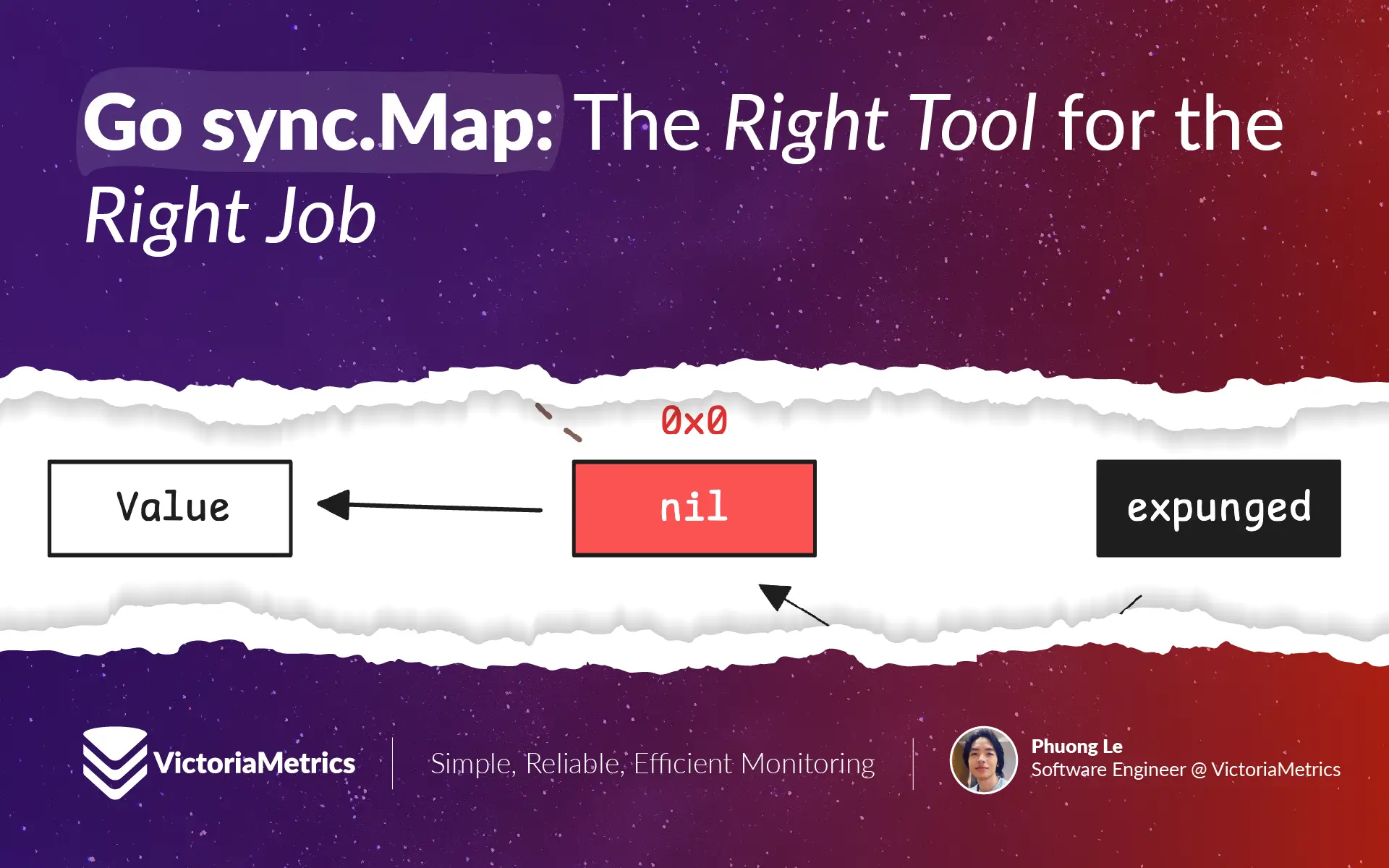
Go sync.Map: The Right Tool for the Right Job
Go’s sync.Map isn’t a magic bullet for all concurrent map needs. It’s got some good tricks up its sleeve, like handling reads without locking, but it’s not always the best choice. This article dives into how sync.Map works under the hood, from its two-map system to the bottom line of expunged entries.
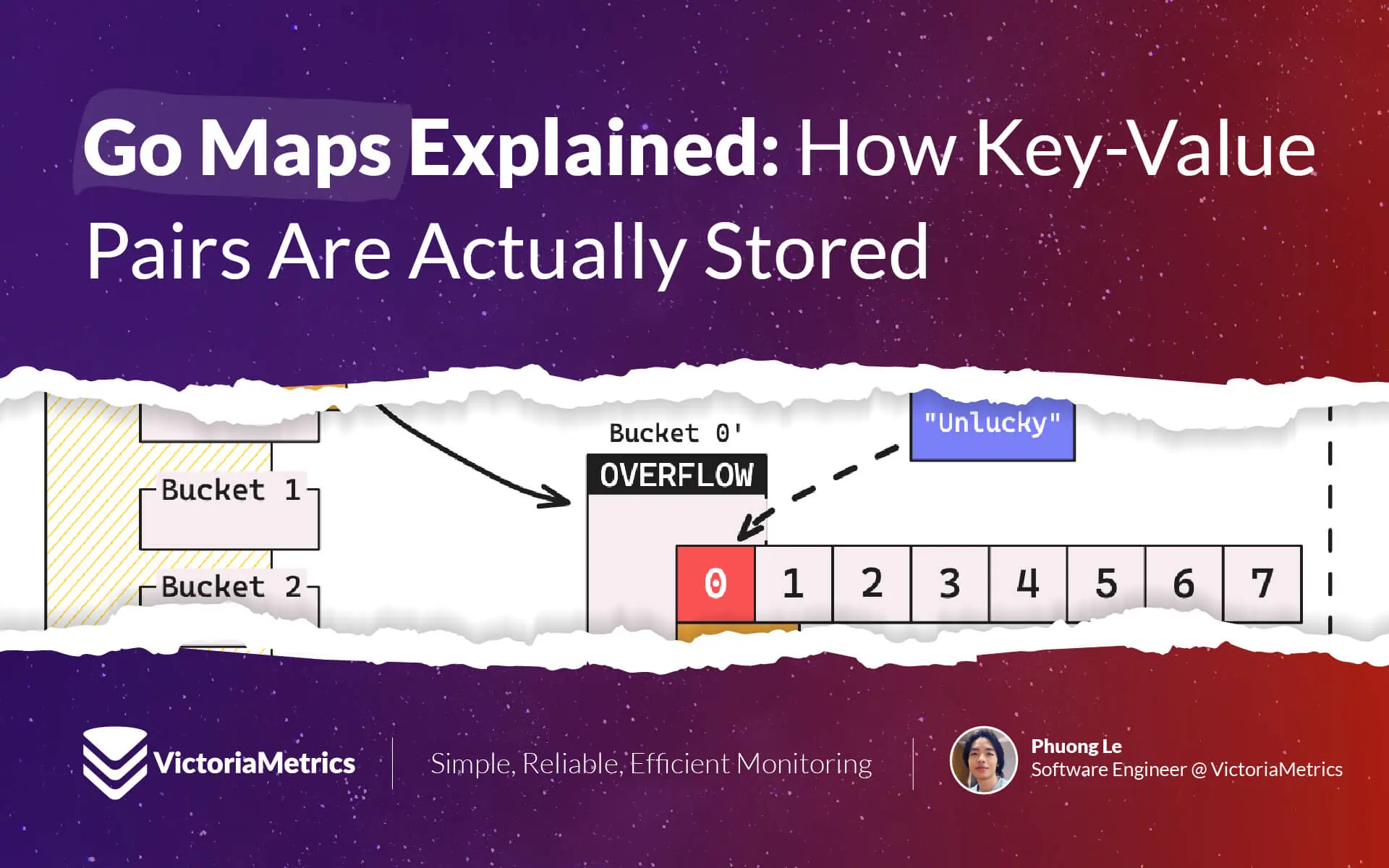
Go Maps Explained: How Key-Value Pairs Are Actually Stored
Map is a built-in type that acts as a key-value storage. Unlike arrays where you’re stuck with keys as increasing indices like 0, 1, 2, and so on, with maps, the key can be any comparable type.