- Blog /
- What's New in VictoriaMetrics Cloud Q4 2025? New tiers, more deployment options, IaC and alerting rules.
What's New in VictoriaMetrics Cloud Q4 2025? New tiers, more deployment options, IaC and alerting rules.
Share:


2025 has been quite a year! As we enter into 2026, we want to share all the great features that VictoriaMetrics Cloud has brought in the last quarter.
Remember that this Quarterly Live Update is available in video format as well here:
Let’s get to it!
New VictoriaMetrics Single Tiers
#
One of the main changes of this last quarter of 2025 has been the introduction of new Capacity Tiers for VictoriaMetrics Single type instances in VictoriaMetrics Cloud. In a nutshell, after a benchmarking exercise, we’ve adjusted our tiers so they follow a linear progression in computing power, quotas/limits and costs for our users. We believe this work gives more flexibility while easing the price model progression as users scale their Observability needs.
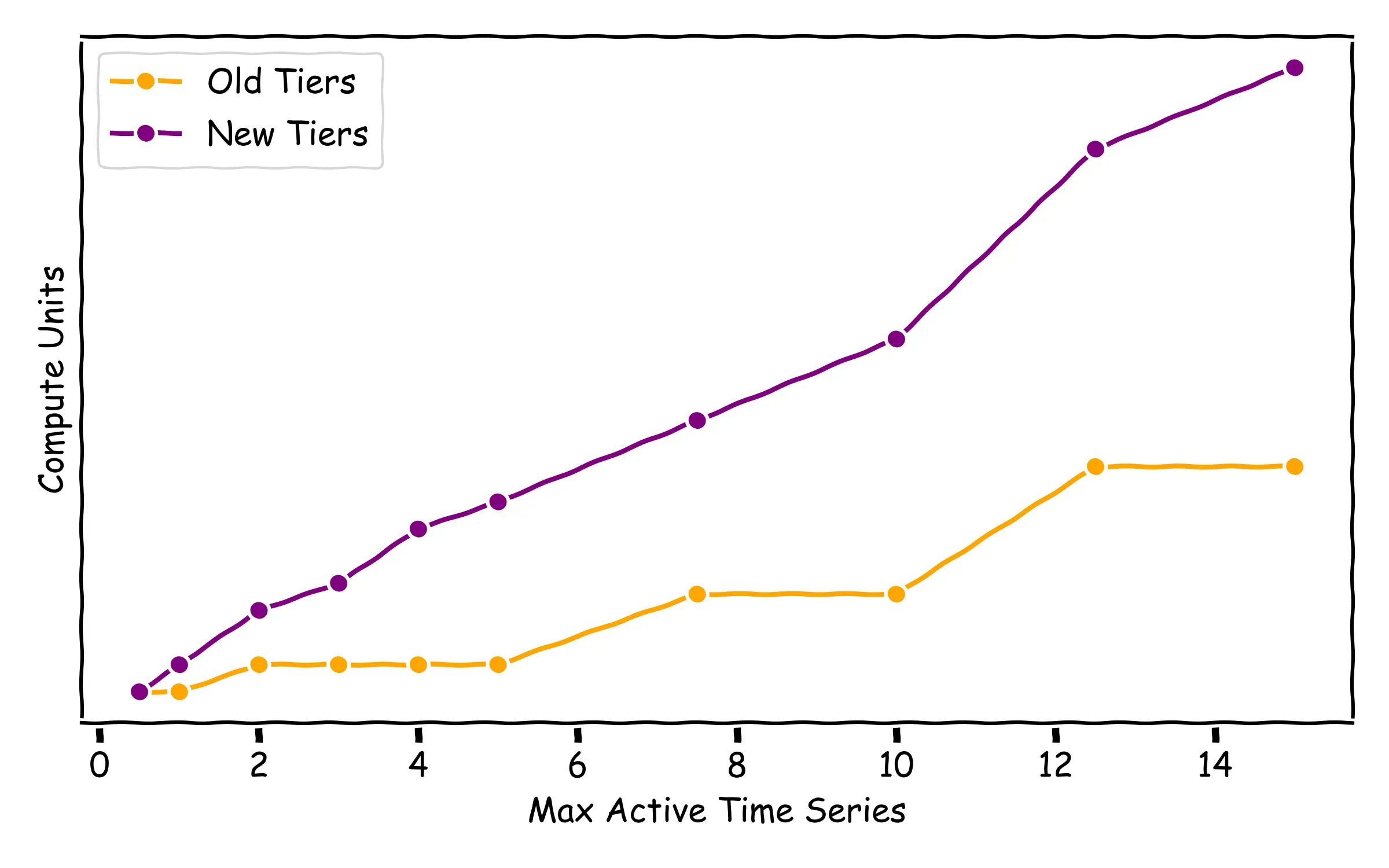
Apart from adding more power and adjusting prices, the UI for instance creation has been simplified and the benchmark results have been published.
For Cluster type deployments (which provide higher SLAs and multitenancy), the main change is that interested users can now open a request for a PoC in which our team will tailor an instance for their requirements, adapting to their needs.
Learn more about the new tiers in the full announcement here.
New US region available: us-east-1 (N.Virginia)
#
VictoriaMetrics Cloud keeps expanding thanks to the fact that more and more users are relying on our platform. It was not long ago that we opened a new region in Singapore, and now we are happily announcing that we are also open for business in the AWS us-east-1 (N.Virginia) region.
This region is special because it is one of the most used worldwide, and we definitely didn’t want to miss the party (with all the fun it entails)! We believe this is great news for those who are already in this region and want to benefit from AWS PrivateLink and lower latency for their observability data.
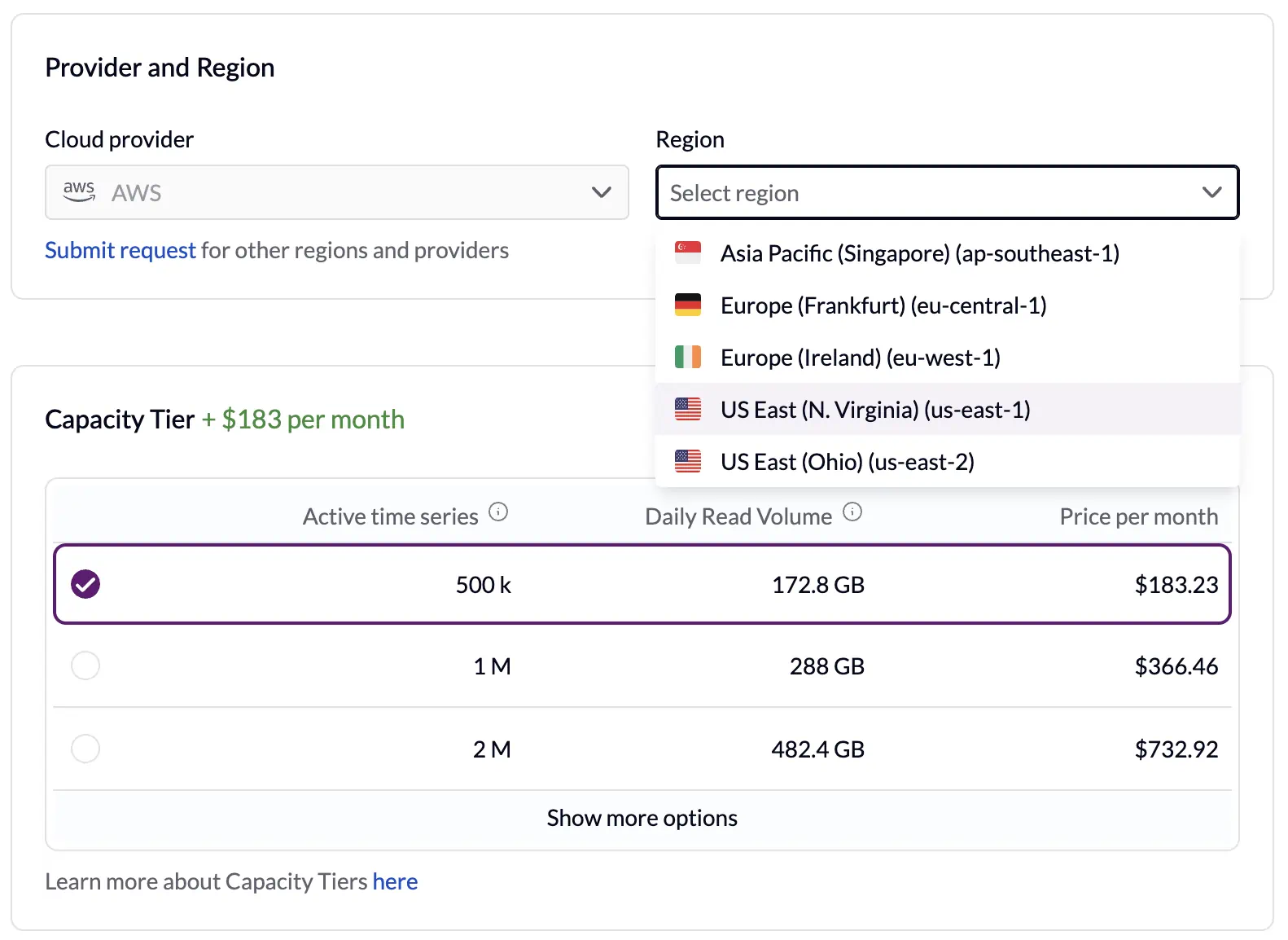
Feel free to give it a go whether you already are a VictoriaMetrics Cloud user, or are just considering VictoriaMetrics Cloud. In this case, let me kindly remind you that a simple Sign Up gives you a free trial for a month (without requiring you to add a payment method).
As usual, contact us if you’d like to see us in other regions!
Notification groups
#
We’ve been after improving our notifications system for quite a while now. That’s why we are very excited to rollout an improved system that helps your team stay informed about critical events, product updates, and account activities, while giving the ability to customize them within different groups. In this way, different users can define how (and what!) to get notified. Notifications are divided into the following interest groups:
- System alerts: for critical updates about platform health and infrastructure
- Billing: is related to notifications about invoices, usage limits, and payment issues
- Product News: updates on new features, improvements, and releases
- Activity: events related to user actions and deployments
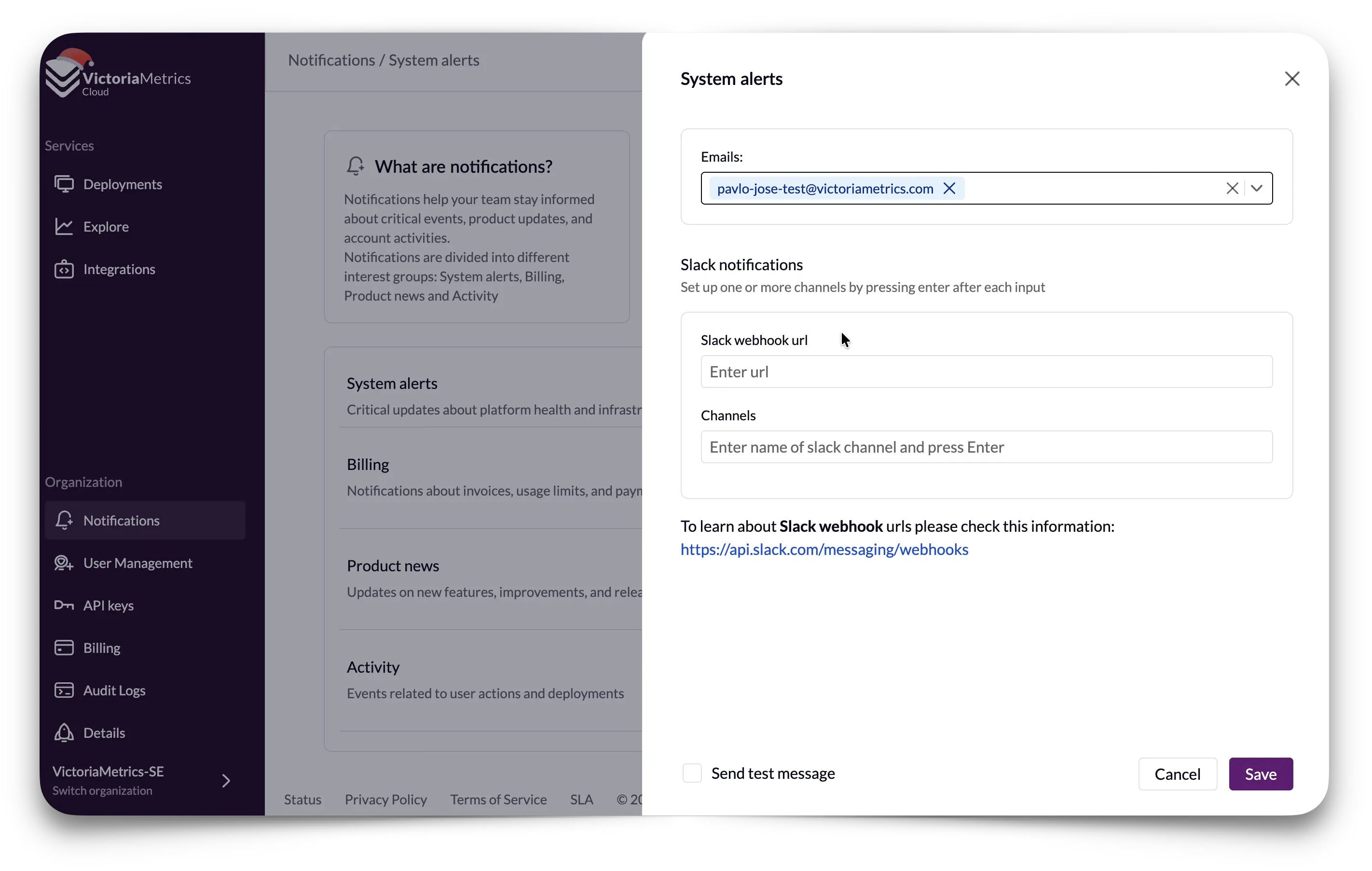
These categories can be used to define which updates and notifications are relevant to you, and set to which email addresses and/or slack channels you want to get your system alerts, at Organization or User level.
Terraform integration: more ways to automate your VictoriaMetrics Cloud instances
#
We do love automating our own actions and that’s why we’ve always wanted to help (and encourage) VictoriaMetrics Cloud users to do the same. Historically, the main way to do that has been via the API, (see our docs) and it’s been great to see how everyone has been using it. In case you haven’t tried it, check everything you can do, the Swagger way, here.
Not long ago we also made public the client library for the VictoriaMetrics Cloud API in go, which provides an idiomatic way to talk with the Product. Check how to integrate in the Github repo.
So what was left? Exactly, being part of the Terraform ecosystem!
Registry
#
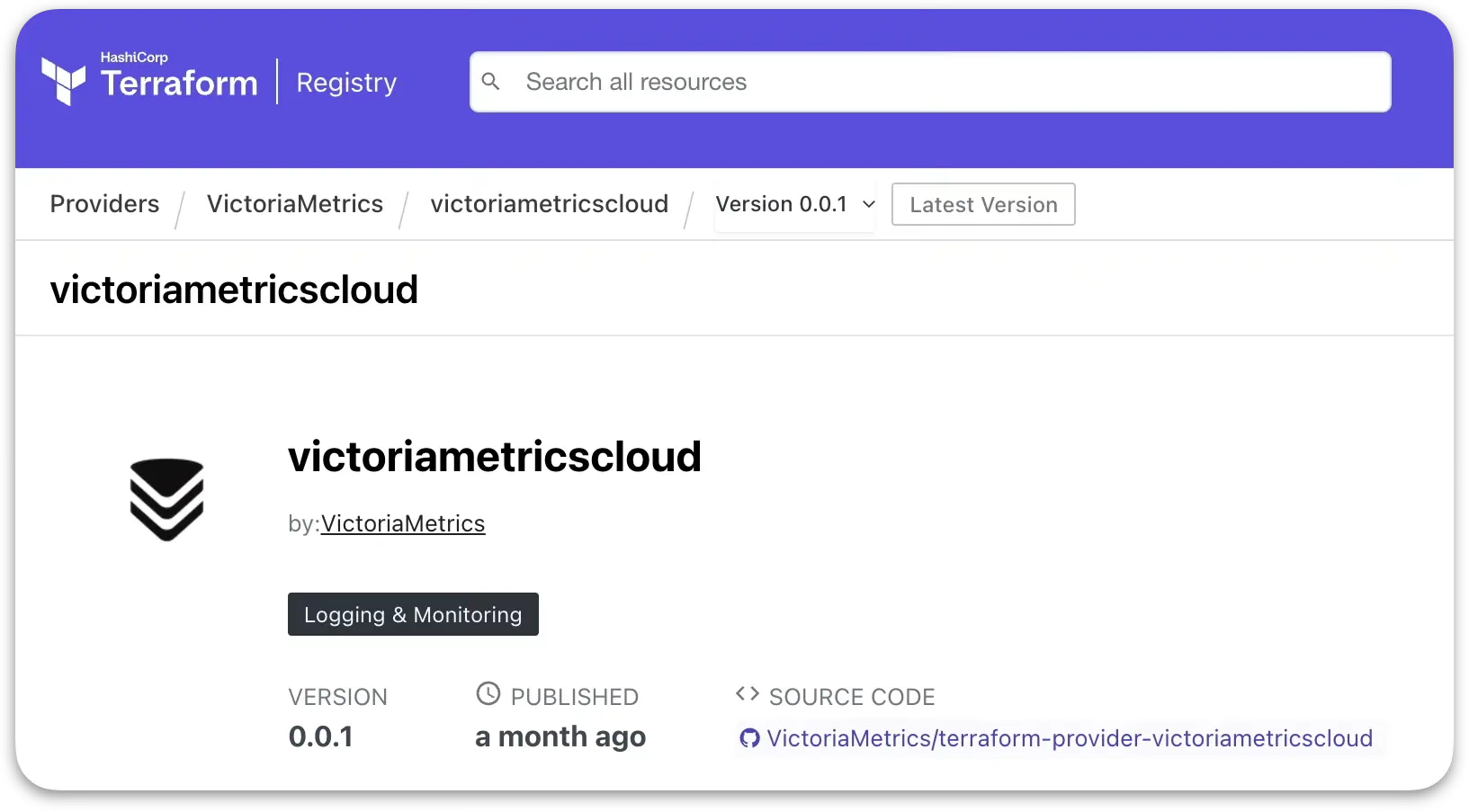
Since last December, our users can deploy and manage their instances via the VictoriaMetrics Cloud provider, available on the Terraform registry. With the implementation made Open Source, and available in this repository, this provider gives a wrapper of the mentioned VictoriaMetrics Cloud API that exposes all resources and data sources (deployments, access tokens, rules, regions…) so you can manage VictoriaMetrics Cloud as part of your Infrastructure as Code.
After saving your API key, this is all it takes for you to add the VictoriaMetrics Cloud provider to your configuration:
terraform {
  required_providers {
    victoriametricscloud = {
      source  = "VictoriaMetrics/victoriametricscloud"
      version = "0.0.1"
    }
  }
}

provider "victoriametricscloud" {
  api_key = var.api_key
}
Terraform Integration
#
But that’s not all. As usual, we wanted to guide users to easily integrate VictoriaMetrics Cloud with the terraform provider. Check out the integration page inside the product, or in the docs with the same embedded experience.
Integrations: New alerting rules
#
Following with integrations, our last main addition this quarter is the inclusion of 9 new Alerting Rules integrations. As with previous integrations of this kind, we are making it easier for those who want to get notified when something is wrong with their stack by importing more of the popular Awesome Prometheus Alerts into the integrations section.
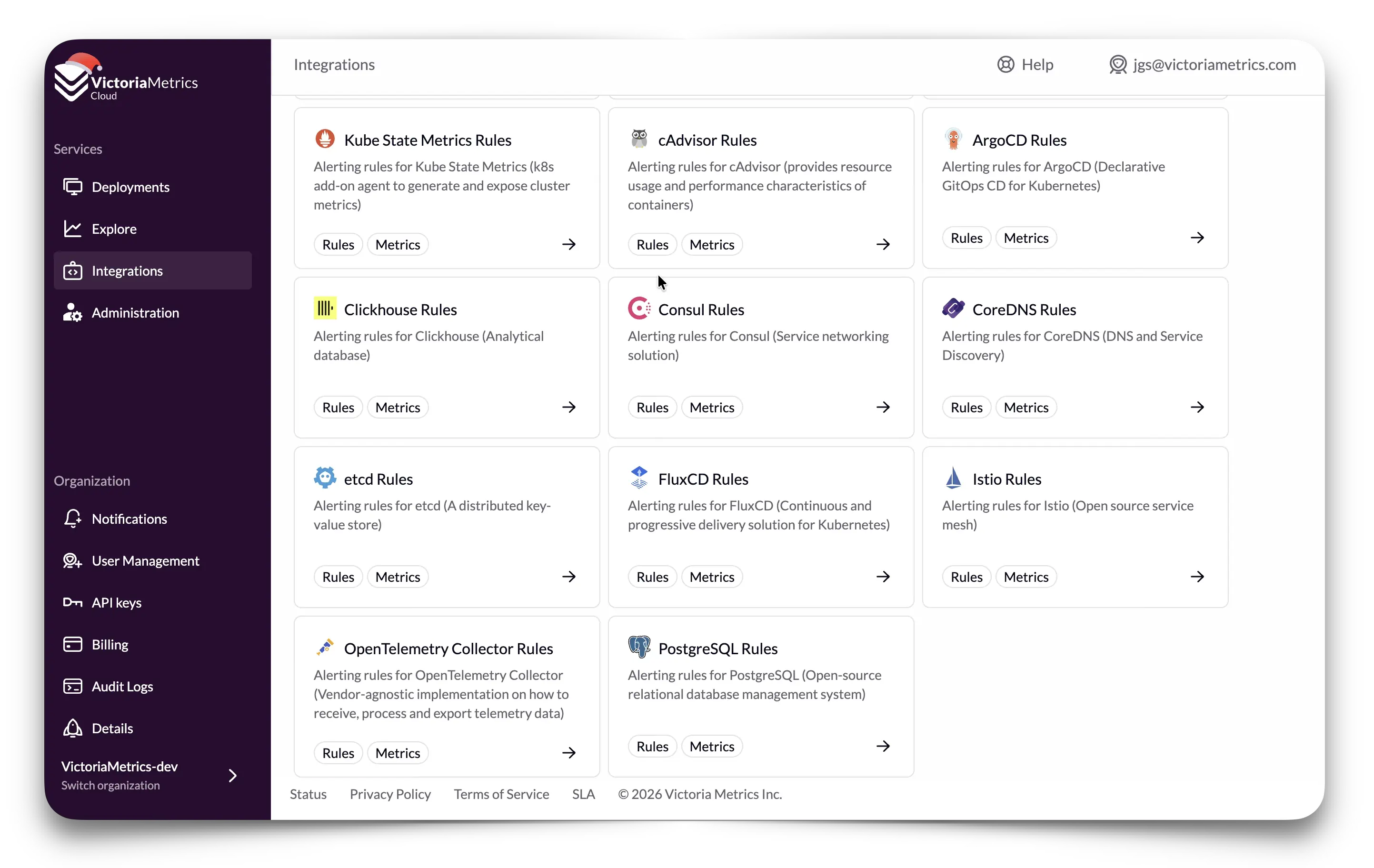
This time, users can benefit from getting out of the box alerting rules for:
- CI/CD: ArgoCD, FluxCD
- Observability agents: OpenTelemetry collector
- Networking/Mesh: CoreDNS, Istio, Consul
- Databases/storage: etcd, PostgreSQL, ClickHouse
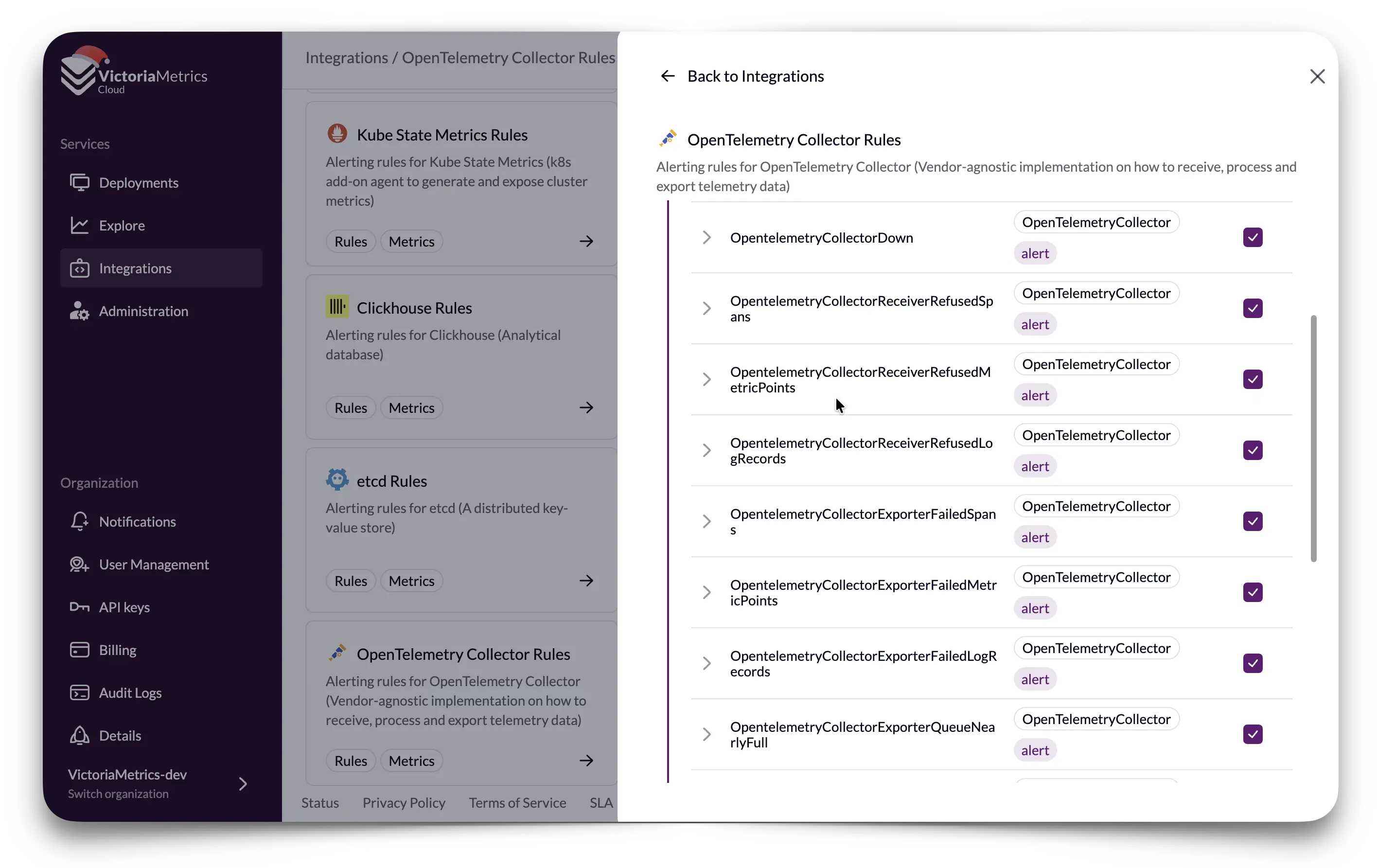
As you can see, by picking from a list of alerts it’s much easier to plan for those situations that may get tricky. Of course, we recommend to only add those alerts that are important to you and actually actionable. This will avoid unnecessary fatigue, letting you focus on what matters, while being certain that you’ll get notified for important events.
Other Improvements
#
We don’t want to take more of your precious time, but this is not all. Among all these great features and additions we just commented, we have also been working on improving our resiliency, making upgrades across the platform, revising our Disaster Recovery procedures and adding more Scalability in some of our components.
There’s a new metric available for users in the Overview and Monitoring pages of every deployment: Data read rate. It shows the amount of data scanned per time unit, and represents the reading effort that the deployment is doing. While mostly influenced by the querying path, it also accounts for VictoriaMetrics periodic merges and deduplications. It took us some effort and discussions but we believe users will finally have a way to understand how their reading load impacts the system performance. This information will help to decide when upgrading or downgrading between tiers.
Other minor improvements include: Access Tokens enhancements in limits, the inclusion of the last usage time in the API and bug fixes. Organization Id is now available for hyperlinks, and new users can see now that higher quotas are automatically enabled upon subscription. Last but not least, we’ve also improved the user experience in Stripe card expiration notifications.
Did you notice the Easter Christmas Egg? :) Let us know in the comments!
What’s Next?
#
We’re so excited to announce that VictoriaLogs is ready, as we’ve finalized the work on backups and tier definition. This means that in the following weeks you can expect VictoriaLogs being part of the VictoriaMetrics Cloud product. This wouldn’t have been possible without the feedback and help from our early adopters, so we want to publicly thank you for all your patience and meaningful reflections. Thanks to you all!
2026 is going to be a great year. See you soon!
And if you haven’t done it already, remember that there’s a free trial when you Sign up for VictoriaMetrics Cloud!
Leave a comment below or Contact Us if you have any questions!
comments powered by Disqus