- Blog /
- Our latest updates across the VictoriaMetrics Observability ecosystem
Our latest updates across the VictoriaMetrics Observability ecosystem
Share:


We’re excited to announce a set of updates across the entire VictoriaMetrics open source products suite — including VictoriaMetrics, VictoriaLogs, VictoriaTraces, the VictoriaMetrics Kubernetes Operator. These improvements bring better performance, stronger security, enhanced metadata visibility, and a smoother experience when running observability at scale.
VictoriaMetrics v1.130.0 & v1.129.0 — Metadata, Performance, and Compatibility Improvements
#
The latest VictoriaMetrics releases introduce major enhancements across some of its core components: vmagent, vmalert, vmctl, as well as their toolset.
New in v1.130.0:
- Metric metadata support (Prometheus-compatible API)VictoriaMetrics can now scrape and store metadata using vmsingle or vmagent and expose it via
/api/v1/metadata. Enable it with-enableMetadata=trueacross vmsingle, vmagent, and vminsert. - Namespace metadata for Kubernetes targetsvmagent now can attach namespace metadata to discovered pods, services, endpoints, and more allowing richer filtering and discovery rules.
- VMUI improvementsThe VictoriaMetrics UI is now faster and more intuitive.
- Better alert templating behavior in vmalertTemplating errors now surface as annotation values while alerts continue to be generated, aligning with Prometheus behavior.
Highlights from v1.129.0:
- vmalert
- Faster startup for groups with long intervals.
- New
nowtemplate function for easier time calculations. - Added support for
alert_relabel_configsper notifier. - Fixed UI search and HTML formatting in annotations.
- vmctl improvements including multiple
--remote-read-filter-labelflags.This is useful in order to narrow down the data being migrated by using more precise filters. - Improved performance for stream aggregation in vmagent with multiple rules. Push operation could utilize all CPU cores now.
- Load balancing fixes in vmauth (3% -> 0.04% deviation).
- s390x builds added for Linux.
- New
/remotewrite-*endpoints for relabel config inspection.
VictoriaLogs v1.38.0 — Security & Operational Intelligence Enhancements
#
New Features
- Log deletion via HTTP APIEnables GDPR-compliant deletion of stored logs. Intended for rare but critical actions such as data-breach cleanup or regulatory enforcement.
- Per-query redaction of sensitive fieldsPlatform owners can hide specific fields (emails, credentials, SSNs, etc.) for some users while full data remains visible to authorized ones — essential for managed platforms and multi-tenant deployments.
- Slow query detectionVictoriaLogs now supports slow query detection and automatically logs queries that exceed the configured execution time thresholds. This helps investigate, optimize slow queries and understand which queries cause long durations or spikes in CPU or memory usage.
Check out the full Changelog for this release!
VictoriaTraces v0.5.0 — OTLP/gRPC Support for Tracing Pipelines
#
VictoriaTraces now includes better compatibility with modern tracing infrastructures.
Key Feature
- OTLP/gRPC ingestion for both single-node and cluster deployments Requires -otlpGRPCListenAddr on VictoriaTraces or vtinsert. This simplifies ingestion from OpenTelemetry SDKs and collectors.
This update makes adopting VictoriaTraces easier for teams standardizing on OpenTelemetry.
Speaking of gRPC, Zhu Jiekun published an article in which he revealed in more detail how support for OTLP/gRPC in the HTTP/2 + easyproto way was added to VictoriaTraces.
VictoriaMetrics Kubernetes Operator — VictoriaLogs and VictoriaTraces support
#
v0.63.0 major update
- This is a very significant release in that the operator now supports VictoriaLogs and VictoriaTraces in both Single Node and Cluster-based versions.
v0.65.0 — Better Prometheus-Operator Compatibility
- scrapeClass & scrapeClassName support across VM*Scrape objectsAdded to VMServiceScrape, VMPodScrape, VMProbe, VMScrapeConfig, VMStaticScrape, and VMNodeScrape. This enhancement smooths migration paths for users switching from Prometheus Operator to VictoriaMetrics.
What’s Next
#
Across the VictoriaMetrics ecosystem, we continue working on:
- Deeper cross-linking between metrics, logs, and traces
- Further metadata improvements
- Enhanced performance for large ingest pipelines
- Improved security and compliance tooling
Thank you for choosing VictoriaMetrics — and stay tuned for more updates!
Leave a comment below or Contact Us if you have any questions!
comments powered by Disqus
You might also like:
VictoriaMetrics 2026 Mid Year Roundup
Take a look at what we shipped in the first half of 2026 across VictoriaMetrics: metrics, logs, traces, and cloud,with improvements in performance, scalability, and usability.
VictoriaMetrics March 2026 Ecosystem Updates
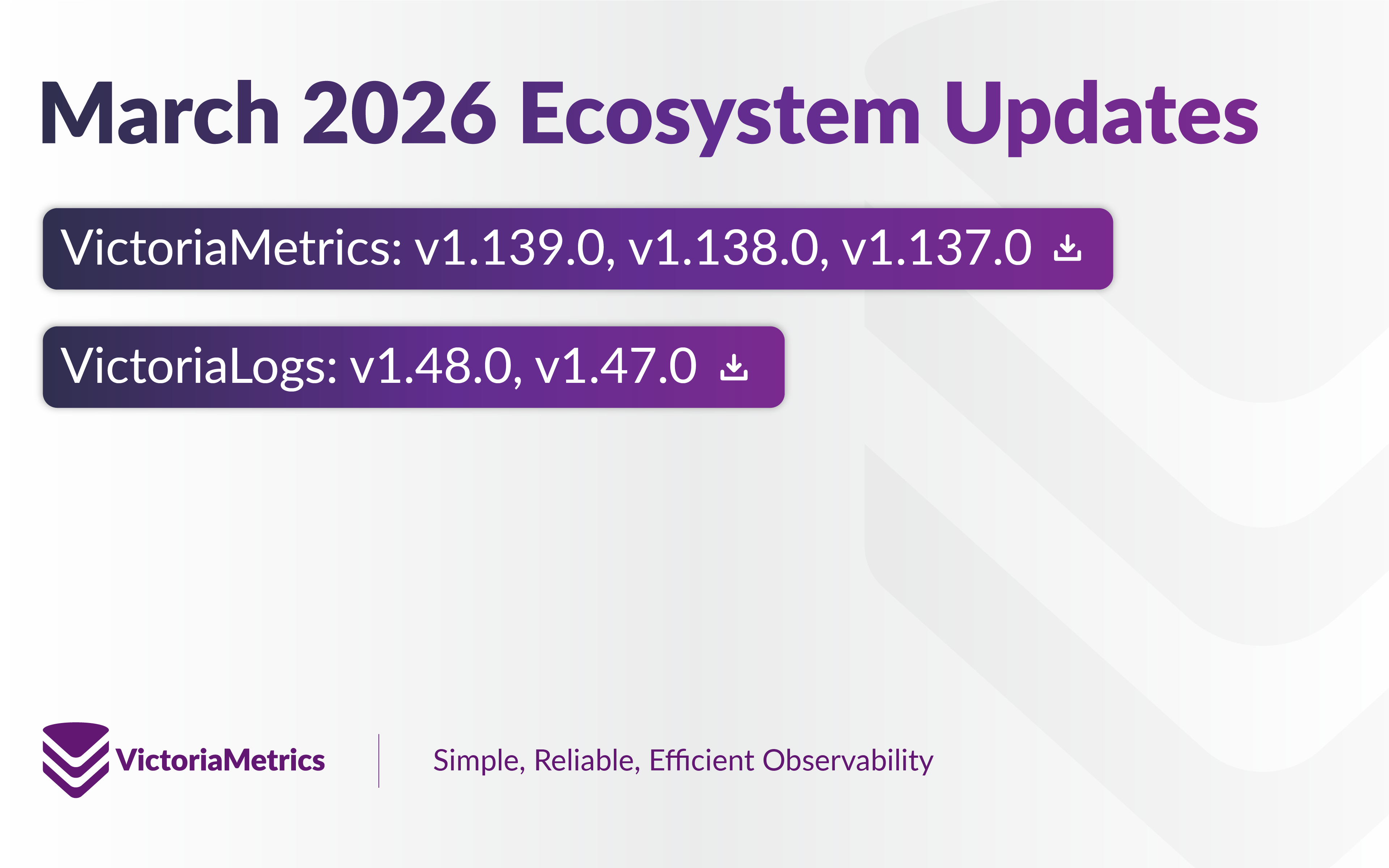
March 2026 VictoriaMetrics Stack releases deliver Grafana Cardinality Explorer, VMUI pagination, JWT auth enhancements, log UI sidebar, and Kubernetes log enrichment for scalable observability. Upgrade now for better UI usability, query performance, and production-ready monitoring workflows.
VictoriaMetrics January 2026 Ecosystem Updates
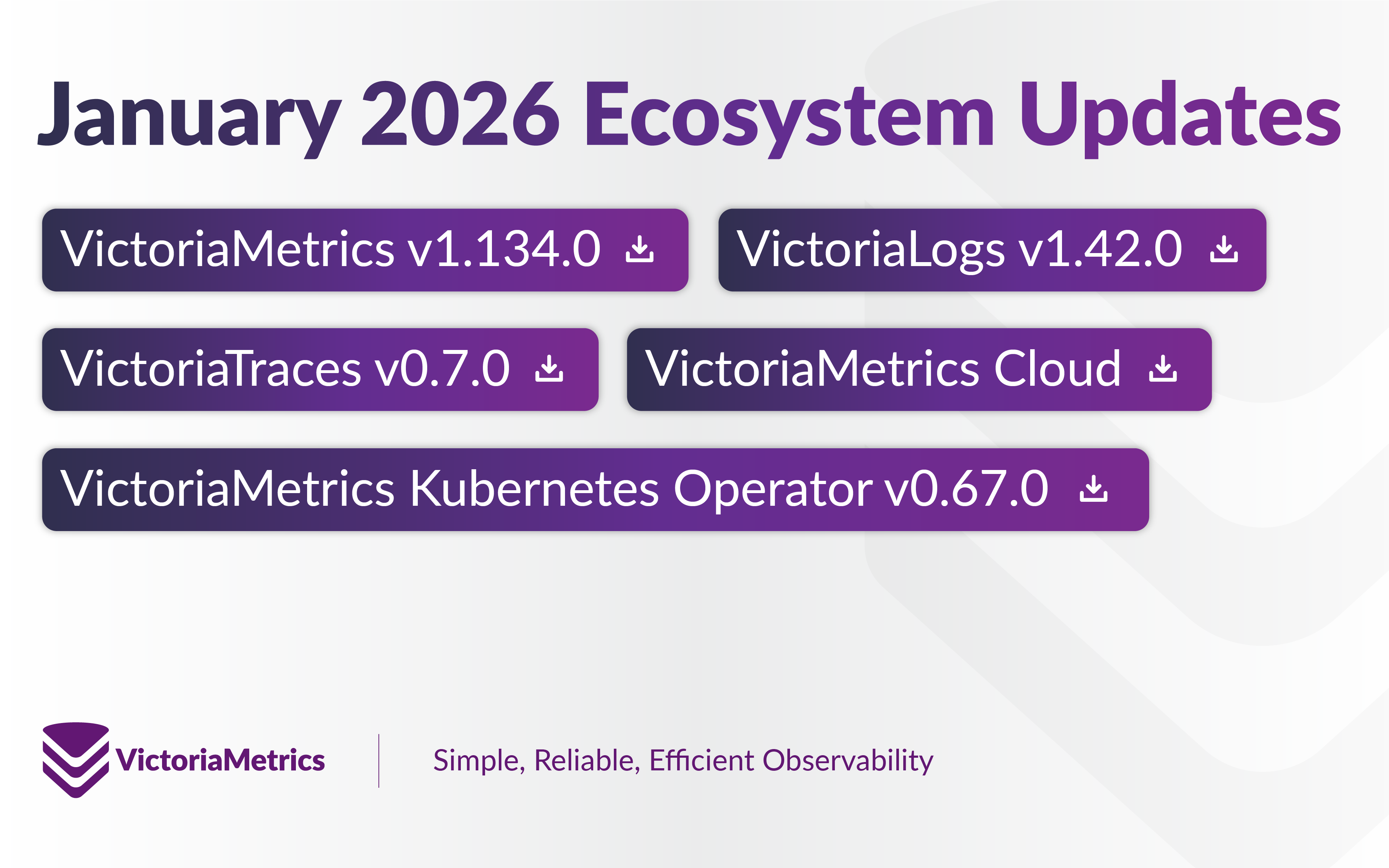
January 2026 updates deliver quality of life improvements, performance optimizations, and tighter Kubernetes integration across the VictoriaMetrics Observability Stack.