- Blog /
- FIPS 140-3 Compatible Builds for VictoriaMetrics Enterprise Components

FIPS 140-3 Compatible Builds for VictoriaMetrics Enterprise Components
Share:


VictoriaMetrics introduces FIPS 140-3 compatible builds for its components, starting with version 1.117.0. These builds utilize Google’s FIPS 140-3 validated BoringCrypto module.
This is critical for customers in regulated environments (federal government, finance, healthcare) to meet FIPS 140-3 cryptographic requirements for data encryption, TLS, and secure communications.
While VictoriaMetrics itself is not a FIPS-certified cryptographic module, these builds ensure all cryptographic operations are handled by the validated BoringCrypto module. This simplifies compliance for system integrators and customers undergoing FedRAMP, HIPAA, or similar audits.
Availability
#
FIPS-compatible binaries are on our GitHub repository; images are on DockerHub or Quay registries.
- Binaries: Attached to enterprise assets, alongside regular versions. Example:
victoria-metrics-darwin-amd64-v1.117.0-enterprise.tar.gz(There is avictoriametrics-prod-fips binaryin the archive). - Container Images:
scratch-based, with a-fipssuffix in tags. Example:v1.117.1-enterprise-cluster-fips. - Architecture Support: Available for
arm64andamd64.
Performance
#
Our internal tests show no measurable impact on resource consumption or read/write request efficiency with FIPS-compatible builds.
CGO support for vmagent’s Kafka integration was disabled for simplification. This only affects the underlying library choice (Go-native vs. C-libraries) and does not impact functionality.
Please Note
#
These VictoriaMetrics builds use FIPS 140-3 validated cryptographic modules (BoringCrypto).
However, VictoriaMetrics as a complete software solution has not undergone formal FIPS 140-3 certification under the CMVP.
Get Started & Try VictoriaMetrics Enterprise
#
Ready to enhance your observability stack with FIPS 140-3 compatible components?
Request a VictoriaMetrics Enterprise Trial License, or contact our Sales team to get more information.
Leave a comment below or Contact Us if you have any questions!
comments powered by Disqus
You might also like:
VictoriaTraces in VictoriaMetrics Cloud: Complete Observability is Here
Announcing VictoriaTraces in VictoriaMetrics Cloud: managed distributed tracing with native OpenTelemetry support, LogsQL for powerful trace analysis, and integrations with Grafana and Jaeger for complete observability, offering predictable pricing and operational simplicity without the overhead of managing a tracing backend yourself.
VictoriaMetrics August 2026 Ecosystem Updates
The VictoriaMetrics team shipped two core releases with important security fixes. The vmanomaly team shipped two updates with improved scaling and more efficient models. Plus, Tech Talks are back, this time demoing AI-assisted incident troubleshooting.
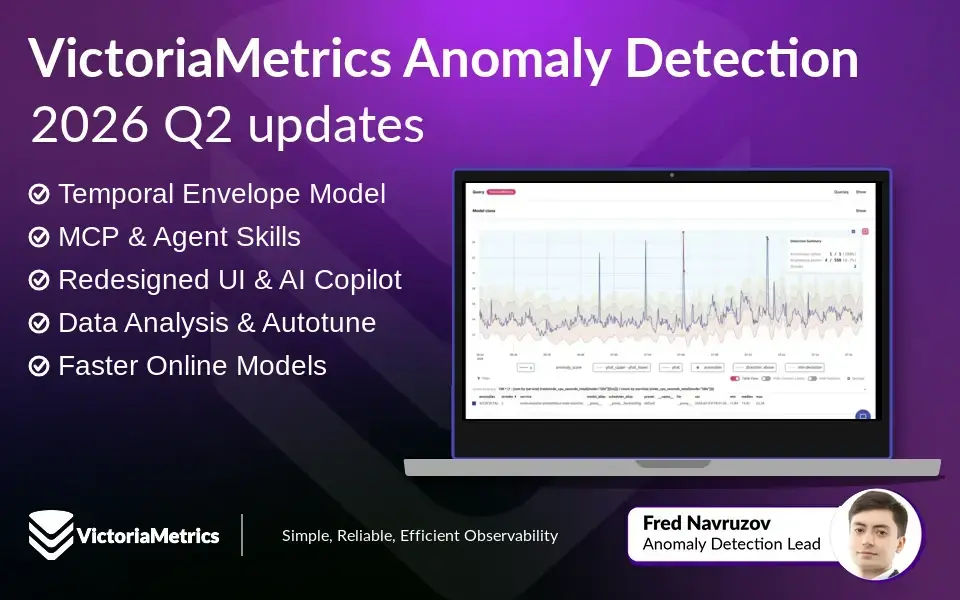
What's new in VictoriaMetrics Anomaly Detection (Q2 2026)
The Q2 2026 vmanomaly update introduces Temporal Envelope, a redesigned UI, faster online-model execution, and an AI-assisted workflow that turns natural-language monitoring goals into tested configurations and alerting rules.