- Blog /
- Meet the VictoriaMetrics team at KubeCon NA, OSMC & OSA Con 2022
Meet the VictoriaMetrics team at KubeCon NA, OSMC & OSA Con 2022
Share:


Meet the VictoriaMetrics team at KubeCon NA, OSMC & OSA Con 2022
#
We’re ending the year with our participation at three great conferences and wanted to share the details with you with the hope of meeting and speaking with some of you in person - and virtually as well!
We’ll be attending the following conferences until the end of the year:
- KubeCon 2022, October 24th to 28th
- We’re already onsite in Detroit as well as online for the virtual KubeCon and we look forward to meeting you if you’re participating
- OSMC - The Open Source Monitoring Conference, November 14th to 16th
- OSA Con 2022 - The Open Source Analytics Conference, November 15th (virtual)
Read below for details on our participation at each conference, where to meet us, details on the talks we’ll be giving, whom from our team will be there, how to register etc.
KubeCon 2022
#
Detroit, October 24th to 28th
Booth S124
The Cloud Native Computing Foundation’s flagship conference gathers adopters and technologists from leading open source and cloud native communities in Detroit, Michigan from October 24 – 28, 2022.
We’ll be present in the exhibition hall at booth S124, look out for the astronaut, and will be sharing VictoriaMetrics chocolates and our experience in all things open source monitoring and time series databases.
Register to attend: https://events.linuxfoundation.org/kubecon-cloudnativecon-north-america/register/
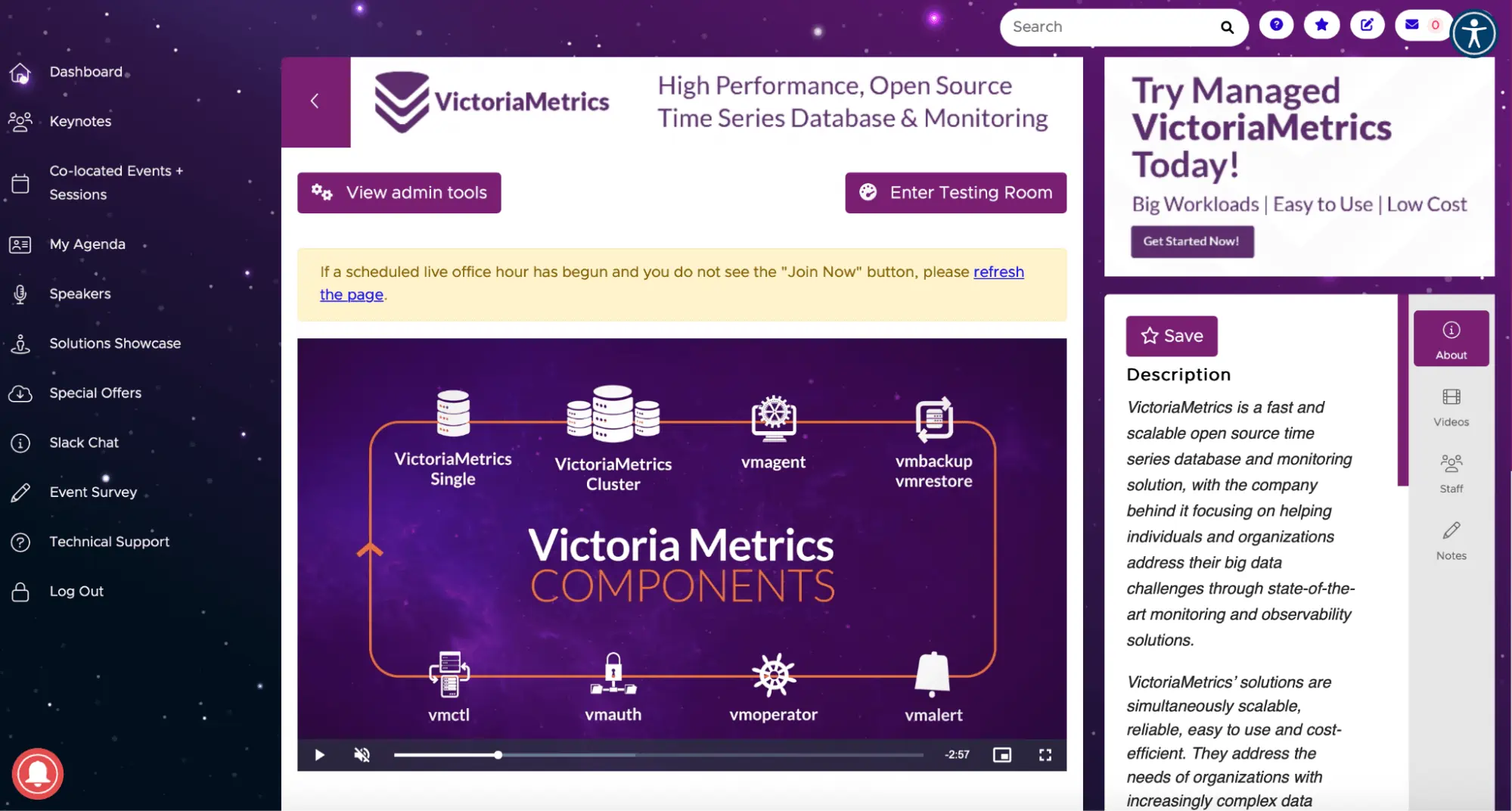
We’ll also be available online in our virtual KubeCon booth (which you can see in the image below), and we look forward to chatting with attendees virtually there as well.
If you check out our Offers, you’ll find a link to the $200 starter pack for VictoriaMetrics Cloud on AWS!
See you in Detroit or see you online!
OSMC - The Open Source Monitoring Conference
#
Nuremberg, November 14th to 16th
Aliaksandr Valialkin, Founder of VictoriaMetrics, will be speaking at this year’s OSMC and we’re delighted to have been extended the invitation for Alex to speak.
VictoriaMetrics: scaling to 100 million metrics per second (video, slides) (EN)
The growth of observability trends and Kubernetes adoption generates more demanding requirements for monitoring systems. Volumes of time series data increase exponentially, and old solutions just can’t keep up with the pace. The talk will cover how and why we created a new open source time series database from scratch. Which architectural decisions, which trade-offs we had to take in order to match the new expectations and handle 100 million metrics per second with VictoriaMetrics. The talk will be interesting for software engineers and DevOps familiar with observability and modern monitoring systems, or for those who’re interested in building scalable high performance databases for time series.
The talk will take place on November 15th at 10:30 CET.

OSA Con 2022 - The Open Source Monitoring Conference
#
We’re excited to be participating in this year’s OSA Con again both as speakers as well as sponsors!
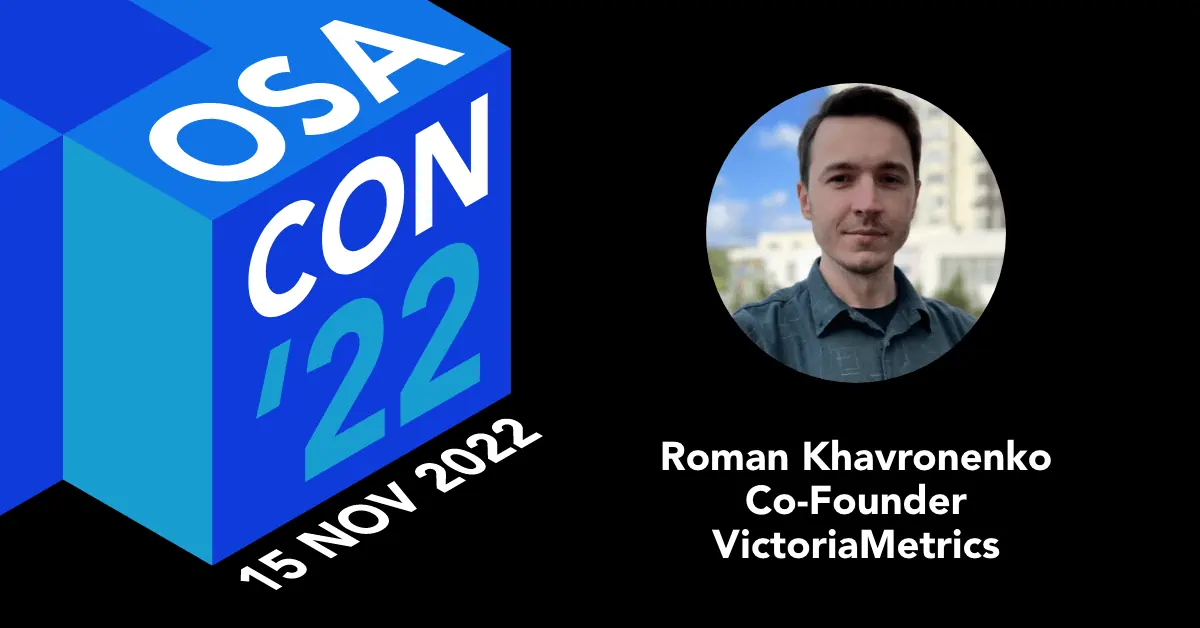
Roman Khavronenko, VictoriaMetrics Co-Founder, will be speaking at 4pm CET on the topic of:
Specifics of data analysis in Time Series Databases
Time series data is special. Not only its nature but also the ways that we store and interact with it. In this talk, we’ll cover the differences between storing time series data in classic relational databases and a new generation of time series databases like VictoriaMetrics and Prometheus.
We look forward to meeting you on the road and virtually at any of these three conferences!
Leave a comment below or Contact Us if you have any questions!
comments powered by Disqus
You might also like:
Heading to London: Meet Our Team at KubeCon Europe 2025
Say hello at booth #N503 for KubeCon Europe 2025 in London, meet our team, and find out about the latest updates on our new VictoriaLogs solution, VictoriaMetrics, anomaly detection capabilities, and more.
Meet Our Team at Scale 22x
Say hello at booth #313 for SCaLE 22x in Pasadena, meet our team, and find out about the latest updates on our new VictoriaLogs solution, the latest VictoriaMetrics updates and more.
Meet Our Team at KubeCon North America 2024
Come say hello at booth R17 for KubeCon 2024 in Salt Lake City, meet our team, and find out about the latest updates on our new VictoriaLogs solution, VictoriaMetrics Enterprise, anomaly detection capabilities, and more