From the article
VictoriaMetrics Observability Blog
Author
- Adam Yates
- Aditya Kulkarni
- Adrian Bridgwater
- Agustín Gallego
- Alex Woodie
- Alexander Marshalov
- Aliaksandr Valialkin
- Aman Agarwal
- Antony Savvas
- Artem Navoiev
- Bill Tanner
- Cer6erus
- Claudio Masolo
- David Marshall
- Denys Holius
- Derek Foster
- Diana Todea
- Dima Lazerka
- Dmytro Kozlov
- Emily Foster
- Fintech Herald
- Fred Navruzov
- Gary Flood
- Gonzalo García Labat
- Ivan Yatskevich
- Jaime Hampton
- Jan Sokol
- Jason Bloomberg
- Jason English
- Jean-Jerome Schmidt-Soisson
- Jesús Espino
- Joab Jackson
- John Seekins
- Jose Gomez-Selles
- Julien Menan
- Karan Virdi
- Laveesh Kocher
- Leigh McGowran
- Lindsay Clark
- Marc Sherwood
- Mark Baker
- Martijn Van Best
- Martin Veitch
- Mathias Palmersheim
- Michelle Sebek
- Nick Gibson
- Nikolay Khramchikhin
- Pablo Fernandez
- Phuong Le
- Rafal Szypulka
- Renato Losio
- Richard Speed
- Roman Khavronenko
- Vadim Alekseev
- Vadim Rutkovsky
- Yurii Kravets
- Zakhar Bessarab
- Zhu Jiekun
No matching authors found.
Observability
- Benchmark
- Community
- Company News
- Customer Stories
- Developer Experience
- Distributed Tracing
- Events
- Go
- Go @ VictoriaMetrics
- High Cardinality
- Kubernetes
- Monitoring
- Observability
- Open Source Tech
- OpenTelemetry
- OTLP
- Performance
- PostgreSQL
- Product News
- Tech Talk
- Time Series Database
- VictoriaLogs
- VictoriaMetrics
- VictoriaTraces
No matching categories found.
Filter: Observability
Blog posts
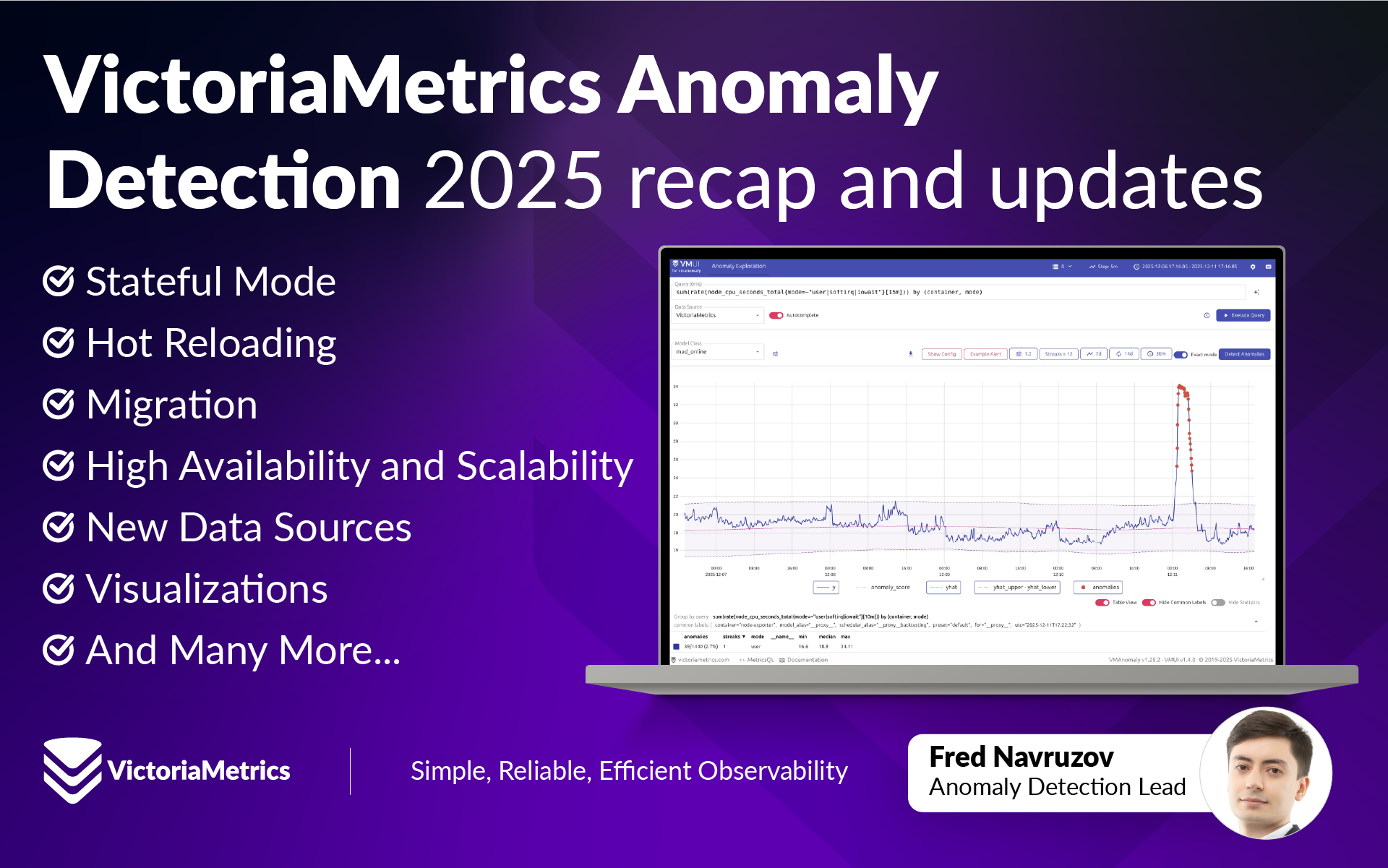
What’s new in VictoriaMetrics Anomaly Detection (2025)
VictoriaMetrics Anomaly Detection has had a productive year with lots of user feedback that has had a major impact on product development. We’ve added improvements across the board: in core functionality, simplicity, performance, visualisation and AI integration. In addition to bug fixes and speedups, below is a list of what was accomplished in 2025.
Vibe coding tools observability with VictoriaMetrics Stack and OpenTelemetry
Learn how to add observability to Vibe Coding Tools using OpenTelemetry and the VictoriaMetrics Stack. This guide explains how to configure popular vibe coding tools to export their metrics telemetry and get insights about your vibe coding sessions.
VictoriaMetrics 2025 Developer Experience: A Year in Review
In 2025, VictoriaMetrics deepened its commitment to open source, community, and developer experience across the global cloud-native ecosystem. This year-in-review reflects on key observability themes, global engagement, OpenTelemetry contributions, and the people and conversations that shaped the year.
AI Agents Observability with OpenTelemetry and the VictoriaMetrics Stack
Learn how to add observability to AI agents using OpenTelemetry and the VictoriaMetrics Stack. This guide explains how to instrument popular LLM frameworks and visualize metrics, logs, and traces in Grafana.
Discarding gRPC-Go: The Story Behind OTLP/gRPC Support in VictoriaTraces
Why did VictoriaTraces build gRPC support without using gRPC-Go? And what are the benefits of adopting a simple HTTP/2 server and easyproto?
Full-Stack Observability with VictoriaMetrics in the OTel Demo
The OpenTelemetry Astronomy Shop demo has long served as a reference environment for exploring observability in distributed systems, but until now it shipped with only a Prometheus datasource. VictoriaMetrics forked the demo and extended it with VictoriaMetrics, VictoriaLogs, and VictoriaTraces, providing insights into VictoriaMetrics’ observability stack where metrics, logs, and traces flow into a unified backend.
Alerting Best Practices
Proper alerting is an art. It is all about foreseeing bad scenarios before they happen, so you can prepare for them. In this article, we go through practical recommendations of approaching the alerting to reduce alerting fatigue and avoid false positives.

Don’t default to microservices: You’ll thank us later!
We believe microservices shouldn’t be the default and that companies should start with monoliths until reality actually demands they scale and shift from one node to a cluster of nodes. As a result, we offer clustering on an open source basis because we want to support realistic growth. Read on for details!
VictoriaMetrics Anomaly Detection: What's New in Q3 2024?
Explore the latest improvements in VictoriaMetrics Anomaly Detection (vmanomaly), including optimizations, online models, multitenantcy and mTLS support.