From the article
VictoriaMetrics Observability Blog
Diana Todea
- Adam Yates
- Aditya Kulkarni
- Adrian Bridgwater
- Agustín Gallego
- Alex Woodie
- Alexander Marshalov
- Aliaksandr Valialkin
- Aman Agarwal
- Antony Savvas
- Artem Navoiev
- Bill Tanner
- Cer6erus
- Claudio Masolo
- David Marshall
- Denys Holius
- Derek Foster
- Diana Todea
- Dima Lazerka
- Dmytro Kozlov
- Emily Foster
- Fintech Herald
- Fred Navruzov
- Gary Flood
- Gonzalo García Labat
- Ivan Yatskevich
- Jaime Hampton
- Jan Sokol
- Jason Bloomberg
- Jason English
- Jean-Jerome Schmidt-Soisson
- Jesús Espino
- Joab Jackson
- John Seekins
- Jose Gomez-Selles
- Julien Menan
- Karan Virdi
- Laveesh Kocher
- Leigh McGowran
- Lindsay Clark
- Marc Sherwood
- Mark Baker
- Martijn Van Best
- Martin Veitch
- Mathias Palmersheim
- Michelle Sebek
- Nick Gibson
- Nikolay Khramchikhin
- Pablo Fernandez
- Phuong Le
- Rafal Szypulka
- Renato Losio
- Richard Speed
- Roman Khavronenko
- Vadim Alekseev
- Vadim Rutkovsky
- Yurii Kravets
- Zakhar Bessarab
- Zhu Jiekun
No matching authors found.
Category
- Benchmark
- Community
- Company News
- Customer Stories
- Developer Experience
- Distributed Tracing
- Events
- Go
- Go @ VictoriaMetrics
- High Cardinality
- Kubernetes
- Monitoring
- Observability
- Open Source Tech
- OpenTelemetry
- OTLP
- Performance
- PostgreSQL
- Product News
- Tech Talk
- Time Series Database
- VictoriaLogs
- VictoriaMetrics
- VictoriaTraces
No matching categories found.
Filter: Diana Todea
Blog posts
Observability's Sixth Sense: Grounding Anomaly Detection in Reality
Learn how VictoriaMetrics combines machine learning, MCP, and natural-language workflows to simplify observability with anomaly detection and reduce operational overhead.
VictoriaMetrics at KubeCon Amsterdam: Community Highlights
VictoriaMetrics participated in KubeCon + CloudNativeCon Europe 2026 in Amsterdam. The team delivered multiple talks covering platform design, Kubernetes observability, and distributed tracing optimization. A real-world case study from Miro showcased a cost-efficient, AZ-aware observability architecture built with VictoriaMetrics. With a 15-person team on site, the booth saw strong interest from users tackling scaling, cost, and performance challenges. The company also hosted its first community after-party, “After Deploy,” co-organized with Varnish and Shipfox, extending discussions beyond the conference.
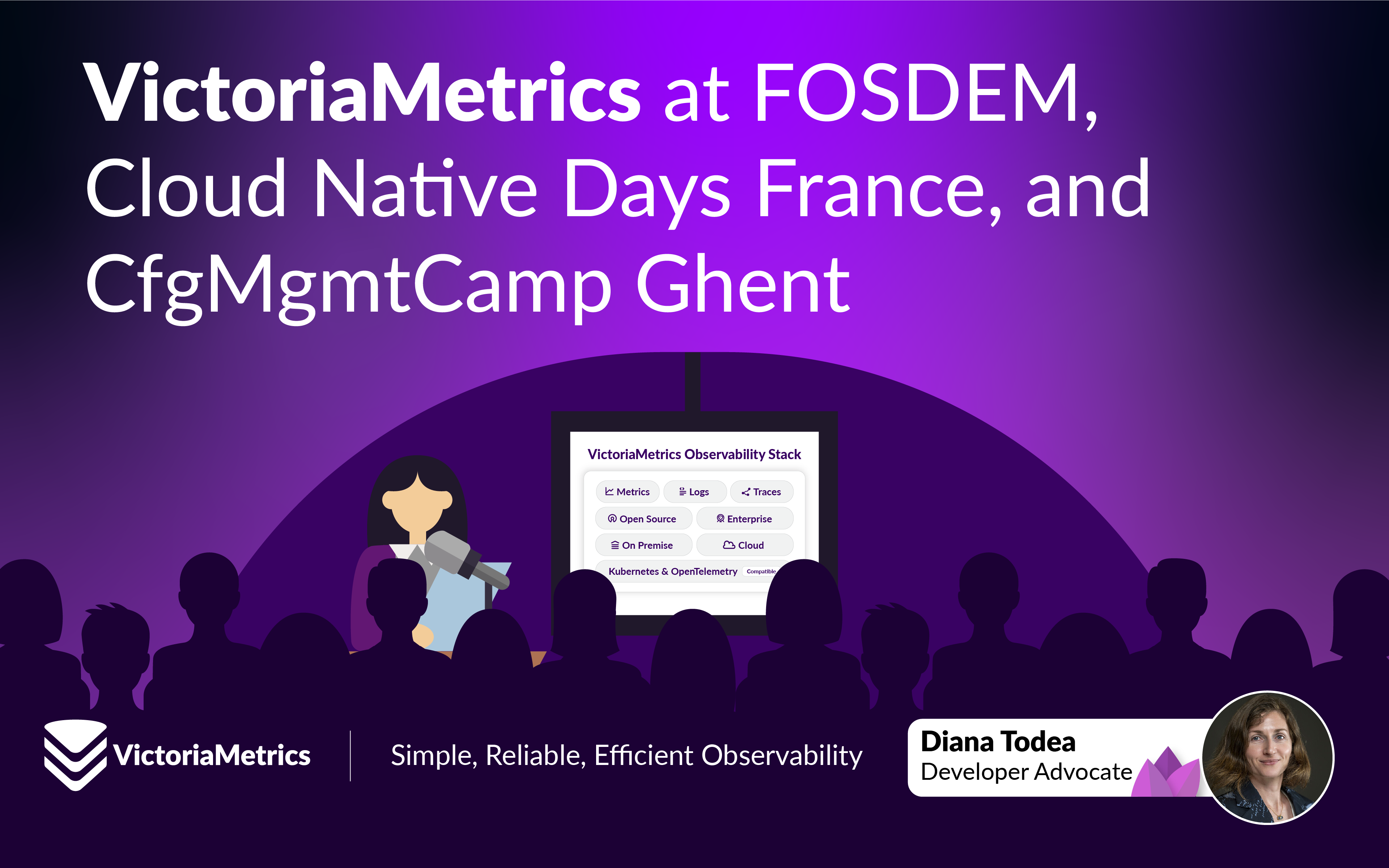
VictoriaMetrics at FOSDEM, Cloud Native Days France, and CfgMgmtCamp Ghent
A developer-focused recap of VictoriaMetrics’ participation at FOSDEM, Cloud Native Days France and CfgMgmtCamp, highlighting open source observability, community feedback and real-world engineering perspectives.
VictoriaMetrics 2025 Developer Experience: A Year in Review
In 2025, VictoriaMetrics deepened its commitment to open source, community, and developer experience across the global cloud-native ecosystem. This year-in-review reflects on key observability themes, global engagement, OpenTelemetry contributions, and the people and conversations that shaped the year.
Full-Stack Observability with VictoriaMetrics in the OTel Demo
The OpenTelemetry Astronomy Shop demo has long served as a reference environment for exploring observability in distributed systems, but until now it shipped with only a Prometheus datasource. VictoriaMetrics forked the demo and extended it with VictoriaMetrics, VictoriaLogs, and VictoriaTraces, providing insights into VictoriaMetrics’ observability stack where metrics, logs, and traces flow into a unified backend.